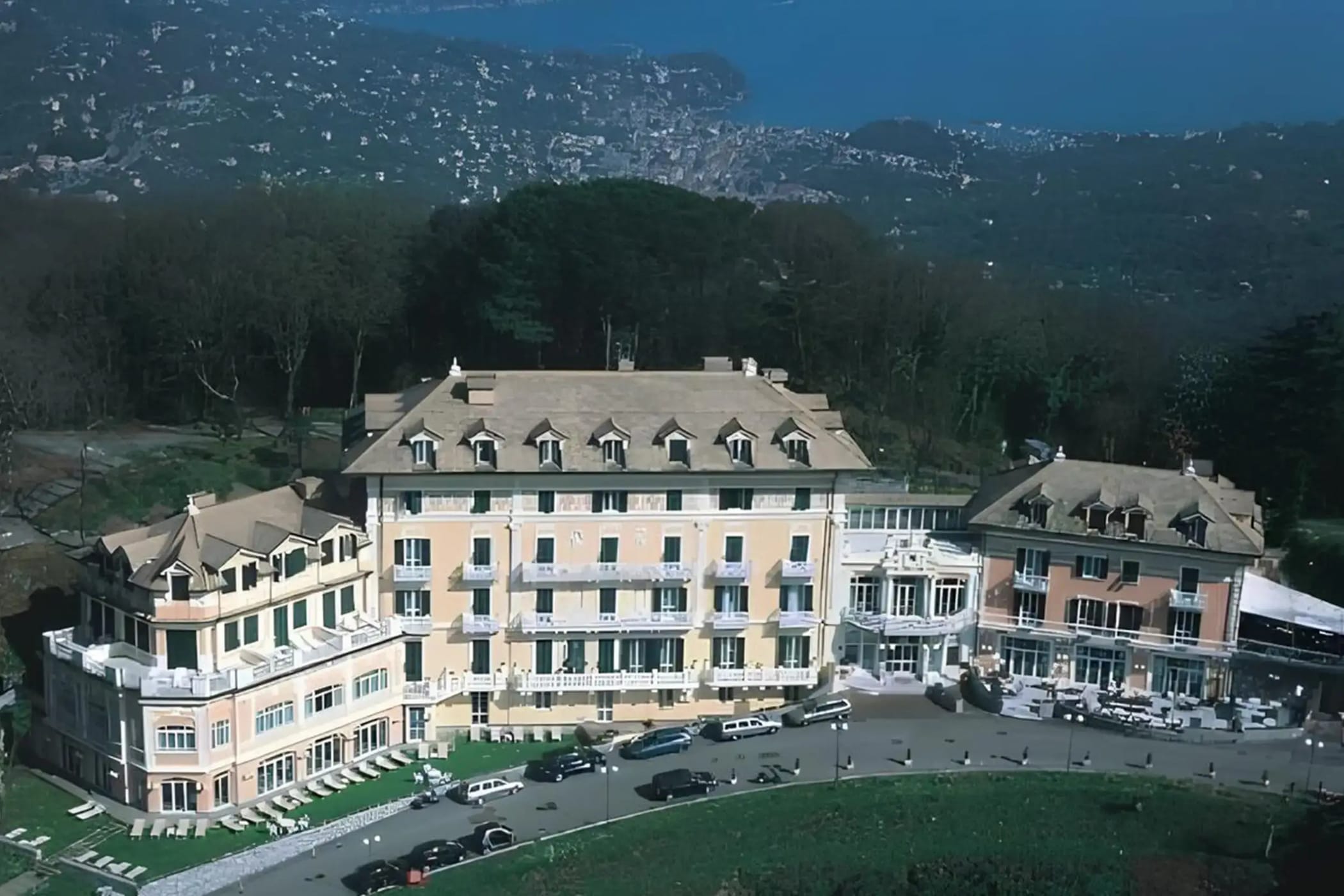
Acquired by the AKNO Group in December 2024 for approximately €10 million, the iconic Liberty-style complex overlooking Portofino remains closed. AN Hotels still lists the property as “opening soon in 2026”. But the real investment question is no longer what was paid for the asset. It is how much capital, time and operating expertise will be required to turn a trophy property into an economically sustainable hotel.
In December 2024, Il Secolo XIX reported on the acquisition of the Portofino Kulm and the relaunch strategy announced by AN Hotels.
The transaction involved the historic complex at Portofino Vetta, within the municipality of Camogli. The property, previously held within the Unipol perimeter after having been inherited from the former Fondiaria group, was acquired by AKNO, the company controlled by entrepreneur Alex Nuhi, for a figure reported by local media to be approximately €10 million.
Founded in 1971, AKNO Group is primarily a real estate developer with a strong track record in business parks, logistics and construction. Its activities are organised across five divisions: Business Parks, Engineering & Construction, Energy, Hotels and Management Services.
Its hospitality operations are conducted through AN Hospitality S.r.l., headquartered in Milan, under the AN Hotelsbrand.
In addition to the Kulm, the group's stated hotel portfolio includes:
-
AN Hotel Milano Melegnano
-
AN Park Hotel Milano Settala
-
AN Hotel Milano San Donato
-
AN Hotel Elysium Portofino Coast in Rapallo
The latter resulted from the redevelopment of the historic Hotel Giulio Cesare, a 33-room 1930s property on the Rapallo seafront.
The Portofino Kulm project, as it emerged from the planning and authorisation procedures involving the Municipality of Camogli and the Portofino Regional Park Authority, was significantly more complex than a conventional hotel refurbishment.
The plans included:
-
an underground parking facility for approximately 70 cars, located uphill from the hotel, which received a favourable opinion from the Park Authority in February 2025;
-
a new swimming pool;
-
a helipad;
-
restoration of the spa, gym and tennis court;
-
restaurant and café facilities;
-
retail areas;
-
redevelopment of the surrounding park;
-
improvements to the private access road.
It is precisely this complexity that makes the Portofino Kulm a particularly interesting hotel investment case.
The August 2026 update
The 2024 story now requires an update.
And that update is arguably the most important part of the story.
First: the Kulm is still not operational
As of mid-August 2026, the official AN Hotels website continues to list:
“AN Hotel KULM Portofino — opening soon in 2026.”
However, no specific opening date is currently indicated.
There does not appear to be a dedicated booking engine operating for the property, nor is there a bookable room inventory associated with the hotel.
Twenty months after closing, therefore, the capital committed to the acquisition has yet to translate into an operating hotel generating hospitality revenues.
This is where the investment analysis begins.
Second: the property is currently presented as a four-star hotel
The official hotel page currently classifies the Kulm as a four-star property.
That deserves attention.
Not because the formal star rating alone determines revenue-generating capacity, but because an asset requiring this level of investment appears likely to need an exceptionally strong economic positioning.
The issue, therefore, is not simply whether the hotel ultimately operates as a four- or five-star property.
The real question is:
what ADR, revenue mix and international demand profile will the Portofino Kulm need in order to generate an adequate return on the total capital invested?
Third: the commercial product does not yet appear fully defined
The room categories currently displayed on the Kulm website — Standard, Superior, Executive, Family and Junior Suite — indicate sizes ranging approximately from 24 to 50 square metres, with descriptions including balconies overlooking the “park and swimming pool”.
However, several elements of the page still refer to the AN Park Hotel Milano Settala.
Some booking links also redirect users to the Settala hotel.
This should be interpreted cautiously. The content may simply represent temporary material used while the website and final hotel proposition are still under development.
Nevertheless, from an investment perspective, it is worth noting.
The Kulm's current digital presence looks more like a pre-opening placeholder than the commercial presentation of a fully defined luxury hospitality product ready to enter the market.
For a trophy asset, this is not a minor issue.
In luxury hospitality, the hotel begins to be sold well before the doors physically open — through positioning, storytelling, international distribution, public relations, sales partnerships and the progressive creation of demand.
Fourth: uncertainty remains around the project's effective timeline
Publicly available sources indicate that the redevelopment process remains complex.
Some non-official open-source references have also suggested that the restoration and expansion works proposed in 2025 had not yet started and have pointed to issues concerning the condition of the complex and its access road.
These references do not constitute a technical or administrative verification.
A definitive assessment of the project's current status would require an on-site inspection and access to the relevant planning and building documentation held by the Municipality of Camogli and the other competent authorities.
For an investor, however, the signal remains relevant.
Because in hotel real estate, timing uncertainty is itself a cost.
The investor's perspective
The Portofino Kulm is what the market would typically describe as a trophy asset.
An almost impossible-to-replicate location.
Views spanning both the Golfo Paradiso and the Gulf of Tigullio.
More than a century of history.
A recognised name.
An exceptional natural setting.
And precisely because the property is exceptional, the transaction should be analysed without falling in love with the asset.
1. The acquisition price is not the cost of the investment
Approximately €10 million for a complex of this size and in this location may appear, in isolation, to be an extremely attractive entry price.
But acquiring the Portofino Kulm does not mean acquiring an operating hotel.
It means acquiring a property that still has to be transformed into one.
That distinction is fundamental.
A conservation-led redevelopment of a historic Liberty-style building in an environmentally sensitive location, combined with significant infrastructure requirements and complicated construction logistics, can generate costs far in excess of the headline acquisition price.
On a purely indicative basis, a hospitality redevelopment of this nature could reasonably fall within a range of approximately €250,000-€400,000 per key, depending on the ultimate specification, the physical condition of the property and the actual scope of works.
That would come before considering additional expenditure associated with:
-
external works;
-
parking infrastructure;
-
swimming pool;
-
potential helipad;
-
mechanical and electrical systems;
-
access and road improvements;
-
landscaping;
-
professional fees;
-
planning and authorisation costs;
-
pre-opening;
-
FF&E;
-
initial working capital.
Assuming, purely for analytical purposes, a final inventory of 80-100 keys, the overall investment could therefore move into an indicative €35-50 million range.
Under such a scenario, the initial purchase price would represent only one component of the total financial exposure.
This illustrates one of the fundamental principles of hotel investment:
the price paid for the real estate is rarely the same as the cost of creating the finished hospitality product.
2. The real risk is time
CAPEX is visible.
Time is much harder to price.
And in many cases, time costs more.
A property located in a highly sensitive landscape, requiring infrastructure works, improved access and multiple regulatory approvals can face a development lead time measured in years rather than quarters.
Every month between acquisition and opening represents capital tied up without hotel operating revenues.
Meanwhile, costs continue to accumulate:
-
property taxes;
-
preservation and maintenance;
-
security;
-
professional and design fees;
-
technical consultancy;
-
financing costs;
-
corporate overhead;
-
pre-opening expenditure.
This is the issue of time-to-cash.
In hospitality, time is not merely an operational variable.
It is a financial variable.
If an investment of tens of millions of euros begins generating cash flow one, two or three years later than originally expected, the impact on IRR can become material.
The key question is therefore not simply:
“How much will it cost to reopen the Kulm?”
The more important financial question is:
“When will the invested capital begin generating cash?”
3. Seasonality is a structural variable
The Kulm possesses an extraordinary characteristic that also creates a distinctive economic challenge.
It is not a hotel by the sea.
It is a hotel above the sea.
Located at approximately 450 metres above sea level, it enjoys an extraordinary setting but does not offer direct access to the traditional beach-resort experience.
That changes the demand model.
Its strongest operating window could reasonably be concentrated between spring and autumn, with opportunities to extend the effective season through:
-
events;
-
weddings;
-
MICE;
-
destination dining;
-
wellness;
-
retreats;
-
international leisure demand;
-
curated local experiences.
The financial objective does not necessarily need to be maximising annual occupancy.
Luxury hospitality can create value through a different combination:
fewer room nights, significantly higher ADR and much stronger ancillary revenue.
4. What economics would the Kulm need to support?
We can therefore build a simple theoretical scenario.
This is not AKNO's or AN Hotels' business plan, which is not publicly available.
It is solely an independent InvestimentiAlberghieri.it exercise designed to understand the potential scale of the economics involved.
Assume:
-
90 keys
-
annualised occupancy of 45%
-
approximately 14,800 occupied room nights
-
room revenue representing 60% of total revenue
-
stabilised GOP margin of approximately 30%
-
hypothetical total investment of €40 million
Generating GOP in the region of €2.7-3.0 million would imply total revenues of approximately €9-10 million.
If rooms accounted for 60% of those revenues, room revenue would therefore be approximately €5.4-6.0 million.
Dividing those revenues by approximately 14,800 occupied room nights produces an implied ADR of roughly:
€365-405.
And that is only a central scenario.
If the final CAPEX were higher, occupancy lower or operating margins more compressed, pressure on both pricing and ancillary revenues would increase accordingly.
This is where the four-star positioning becomes economically interesting.
Not because a four-star hotel cannot command a high ADR.
But because sustaining rates close to or above €400 requires a product, distribution strategy and international demand profile typically associated with the luxury segment.
The real comparison, therefore, is not between an administrative four-star and five-star classification.
It is between:
the capital invested and the hotel's ability to generate revenues consistent with that capital.
5. PropCo and OpCo do not create value in the same way
AKNO was built as a real estate business.
Its core model has historically focused on development, construction and the ability to create and monetise income-producing properties.
Hospitality works differently.
A hotel's value creation process does not end when construction is completed.
That is when it begins.
Value is then built over the following years through:
-
revenue management;
-
distribution;
-
reputation;
-
service delivery;
-
brand positioning;
-
CRM;
-
international demand generation;
-
management control;
-
food and beverage;
-
events;
-
human capital.
This is where PropCo and OpCo need to be treated as two distinct value-creation engines.
The owner of the real estate and the operator capable of maximising hotel performance can be the same party.
They do not necessarily have to be.
In the case of the Kulm, a proprietary hotel brand still building its market position will need to demonstrate that it can develop an international distribution capability consistent with a luxury product capable of sustaining premium ADRs and meaningful demand from markets such as the United States, the United Kingdom, continental Europe and the Gulf.
From an industrial perspective, several models could theoretically be considered.
These include:
a management agreement with an international operator;
affiliation with an upper-upscale or luxury soft brand;
membership in international luxury hotel networks;
or
a structured separation between PropCo and OpCo, potentially allowing an industrial operating partner to enter the project.
None of these options should be interpreted as necessarily representing the appropriate solution for the Kulm.
The broader point is that, in an investment of this scale, the operating structure becomes an integral part of the financial underwriting.
The real value is not in the building
The Portofino Kulm case points to a much broader dynamic in Italian hospitality real estate.
There is no absolute shortage of properties.
Nor is there necessarily a shortage of capital.
The real scarcity often lies in the expertise required to transform a complex property into a hospitality business capable of producing an income statement consistent with the capital invested.
Long-closed trophy assets naturally attract real estate capital.
The entry price may look inexpensive compared with perceived value.
The location can be unique.
The history compelling.
The architecture may immediately suggest a great hotel.
But in hospitality, value is not ultimately measured in square metres.
It is measured by the ability to convert those square metres into:
ADR × occupancy × operating margin × duration of cash flows.
This is why the investment structure should ideally be designed before the acquisition, not afterwards.
First comes the product.
Then the target segment.
Then the market.
Then the operating model.
Then the business plan.
Only after those variables have been established does the economically sustainable value of the real estate emerge.
Not the other way around.
Portofino Kulm: the question that matters
The Kulm is an extraordinary asset.
It deserves to be restored.
Its reopening would represent an important addition not only for Camogli but for the broader tourism economy of the Tigullio and the Ligurian Riviera.
From an investment perspective, however, the central question is not whether the property is beautiful.
That is self-evident.
The question is:
what financial, corporate, commercial and operating architecture can minimise the time between capital deployment and the first euro of cash generated by the hotel?
Because in major hospitality redevelopment projects, success is not simply about reopening.
It is about reopening with a product capable of remunerating the capital required to get there.
That is what makes the Portofino Kulm more than a real estate story.
It makes it a case study in Italian hotel investment.
We will continue to follow the project.
The analysis does not end here
At InvestimentiAlberghieri.it we continuously publish analyses of hotel assets undergoing transformation, closed hotels, redevelopment opportunities, judicial auctions, M&A transactions and debt restructuring across the Italian hospitality market.
If you are considering the acquisition of a closed or underperforming hotel, or require an independent second opinion on a hospitality redevelopment business plan, Investhotel.it provides information on our advisory activities, including operating hotel valuations, operational due diligence, PropCo/OpCo structuring, operating model analysis, management agreements and hotel lease negotiations.
For the industrial and operating side — organisational design, USALI management control, revenue management, executive selection, temporary management and pre-opening — visit HotelManagementGroup.it.
Professional background, publications, academic work and institutional activities are available at RobertoNecci.it.
Are you assessing a hotel acquisition, redevelopment or repositioning project in Italy?
Contact info@investimentialberghieri.it for an initial assessment of the opportunity and to discuss a potential advisory mandate.
Methodology and sources
This article has been prepared exclusively on the basis of publicly available information as of the publication date, including Il Secolo XIX (11 December 2024 and 19 February 2025), Il Giornale d'Italia (13 December 2024), Levante News, Pambianco Hotellerie, the official AKNO Group announcement dated 13 December 2024, the official AN Hotels website as consulted in August 2026 and publicly available documentation relating to the property.
References to the status of the works originating from non-official open sources are reported solely as informational signals and do not constitute technical, legal, planning or administrative verification.
All figures relating to CAPEX, room count, occupancy, ADR, revenues, GOP and total investment identified as analytical assumptions are independent estimates by InvestimentiAlberghieri.it, prepared solely for analytical purposes. They do not represent actual data, forecasts or business plans belonging to AKNO Group, AN Hotels or any other party mentioned in this article.
The owners and any parties referred to in this article may request corrections, clarifications or documentary updates at any time by contacting the editorial team.