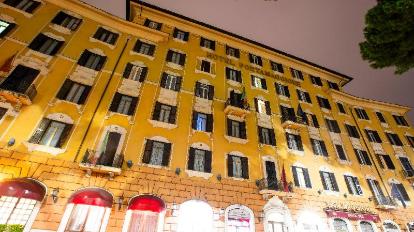
On 17 February 2026, the Court of Milan placed SHG Hotel Roma S.r.l., the company historically associated with the operation of Rome’s Hotel Porta Maggiore, into judicial liquidation. The company had already entered unified insolvency proceedings in July 2024 and reached the final stage of distress after a dramatic financial deterioration: from €7.57 million of revenue in 2019 to €1.55 million in 2022, when it recorded a loss of almost €8.9 million, before revenue effectively collapsed to negligible levels in 2023. Yet while the former operating company has entered judicial liquidation, the asset in Piazza di Porta Maggiore has not disappeared from the hotel investment market. It is undergoing a major redevelopment commissioned by Yellow Tree Real Estate, involving complete strip-out, structural strengthening throughout the building, a reduction in historical room inventory from approximately 206 to 192 keys, and a future international operator. It is one of the clearest examples in the Italian hospitality market of a fundamental principle: Distressed OpCo ≠ Distressed Real Estate. But the case teaches something even more important. Before investing in a distressed hotel, investors must identify which component actually failed — location, product, operations, contractual structure, cost base, capital structure, management or distribution — because a turnaround creates value only when it preserves what worked, removes what failed and recapitalises what remains.
The central thesis is:
Distressed OpCo
≠
Distressed Hotel Real Estate.
But the real question is:
Where Did the Distress Actually Sit?
For investors operating in the hotel investment market, this distinction is critical.
Because:
Hotel Distress
is not a single category.
It is the result of one or more problems embedded in:
Asset
Product
Operations
Contract Structure
Capital Structure
Management
Distribution.
The Porta Maggiore case is therefore particularly useful because it allows us to observe, at the same time:
the destruction of corporate value
and:
the reconstruction of hotel real estate value.
First Certainty: SHG Hotel Roma Is in Judicial Liquidation No. 93/2026
SHG Hotel Roma S.r.l. was placed into:
Judicial Liquidation No. 93/2026
on:
17 February 2026
by the:
Court of Milan.
But the crisis did not begin in 2026.
The company had already entered:
Unified Proceeding No. 679/2024
opened on:
11 July 2024.
The sequence is therefore:
Operating Stress
→
Unified Insolvency Proceeding
→
Judicial Liquidation.
But this is only:
the corporate chain.
It does not automatically coincide with:
the real estate chain.
The Financial Trajectory Shows the Collapse of the Operating Platform
Available financial statements report:
2019 — revenue €7,566,930
2020 — €1,897,570
2021 — €2,990,052
2022 — €1,549,651
with a 2022 loss of approximately:
€8,903,984.
In 2023, reported revenue fell to:
€887
with a loss of approximately:
€2,625,787
and deeply negative shareholders’ equity.
This was no longer simply:
hotel underperformance.
It was:
operating platform collapse.
Revenue Collapse ≠ Asset Collapse
The first mistake would be to conclude:
the company failed → the hotel had no value.
That does not follow.
A hotel contains at least three distinct layers of value:
Real Estate
Operating Business
Brand / Commercial Platform.
When the operator fails, the following may be destroyed:
equity;
goodwill;
working capital;
contracts;
brand value;
customer relationships.
But the following may continue to exist:
underlying real estate value.
Therefore:
OpCo Insolvency
≠
PropCo Insolvency.
Liquidation of the OpCo ≠ Liquidation of the Hotel Real Estate
This distinction is fundamental.
The judicial liquidation of SHG Hotel Roma should not automatically be interpreted as:
a judicial sale of Hotel Porta Maggiore.
The corporate and real estate trajectories are currently distinct.
The equation is:
SHG Corporate Distress
≠
Porta Maggiore Property Distress.
And that separation is precisely what makes the case so interesting.
Porta Maggiore Today: More Than 4,500 sqm and 192 Rooms
The current project involves:
more than 4,500 sqm
and:
192 rooms
intended for:
an international operator.
The project client identified publicly is:
Yellow Tree Real Estate.
The redevelopment includes:
complete strip-out;
structural strengthening;
reinforcement of beams;
floors;
walls;
roofs;
and upgrading to higher international hospitality standards.
The future Porta Maggiore is therefore not:
the old hotel reopened.
It is:
a new hospitality asset created within an existing real estate shell.
Hotel Renovation ≠ Structural Repositioning
This distinction matters.
A:
cosmetic refurbishment
might include:
painting;
new FF&E;
bathroom refresh;
lighting.
Porta Maggiore is instead undergoing:
deep redevelopment.
The formula is:
Legacy Hotel
−
Legacy Internal Platform
Structural Reset
New MEP
New Room Product
New FF&E
New Operator Standards
=
New Hospitality Asset.
206 Legacy Keys → 192 Repositioned Keys
The former Porta Maggiore was historically reported as having:
206 rooms.
The new project provides for:
192.
That is:
14 fewer rooms
or approximately:
−6.8%.
At first glance:
fewer rooms.
But the real test is:
fewer rooms, more value?
Maximum Key Count ≠ Maximum Asset Value
Reducing the number of rooms may create:
larger guestrooms;
better bathrooms;
accessible rooms;
technical shafts;
improved circulation;
more efficient BOH;
better acoustics;
a stronger category mix.
The equation is:
Lost Contribution from Removed Keys
vs
Higher ADR
Higher Occupancy
Better Guest Experience
Lower Maintenance Complexity
Greater Product Consistency
Higher Stabilised Value.
If the second block exceeds the first:
Key Reduction = Value-Creative Rationalisation.
Key Quantity ≠ Key Value
The new asset should be measured on:
GOP per Saleable Key.
Not on the number of doors.
The correct sequence is:
Physical Inventory
→
Product Design
→
Operator Standards
→
Final Saleable Keys
→
ADR
→
Occupancy
→
RevPAR
→
GOP.
The Core Framework: Distress Attribution Matrix
This is the decisive analytical layer.
When a hotel becomes distressed, investors need to attribute the distress.
It is not enough to say:
“the hotel was losing money.”
The question is:
why?
The framework can be structured across seven dimensions.
1. Location Risk
Question:
was the location the problem?
In the case of Porta Maggiore, Rome is experiencing record levels of tourism demand.
The location benefits from:
strong urban connectivity;
proximity to San Lorenzo;
proximity to San Giovanni;
rapid access to multiple parts of the city.
But it also faces:
intense urban activity;
traffic;
noise;
less prime-tourist walkability than Rome’s most prestigious historic-centre submarkets.
The equation is:
Connectivity Premium
−
Noise / Walkability Penalty
=
Net Location Advantage.
The fact that new real estate capital is being deployed into the property suggests that:
location failure
does not appear to be the primary source of distress.
Therefore:
Location Risk: likely secondary, not structural.
2. Product Risk
The former product was:
three-star;
more than 200 rooms;
partly oriented towards groups;
with rooms and common areas showing signs of obsolescence.
Historical weaknesses included:
room quality;
acoustics;
layout;
guest experience;
product consistency.
The new project:
reduces the room count;
strips the building back;
reconstructs structural and internal elements;
introduces international standards.
This points to:
Product Obsolescence
as an important component of the legacy model.
Therefore:
Product Risk: material.
3. Operating Risk
In 2019 the company generated:
more than €7.5 million of revenue
but an extremely weak bottom-line result.
This demonstrates:
Revenue Scale ≠ Operating Profitability.
Areas requiring analysis include:
payroll;
energy;
distribution;
departmental margins;
F&B economics;
maintenance;
central overhead;
management efficiency.
Public information does not allow the failure to be attributed to any single operating line.
But it is reasonable to conclude that:
the operating model did not convert revenue into sufficient sustainable profitability.
Therefore:
Operating Risk: high.
4. Lease / Fixed-Cost Risk
An operating company can fail even with healthy demand if it carries:
rent;
minimum guarantees;
fixed obligations
that are not aligned with the GOP the hotel can generate.
Due diligence should therefore reconstruct:
rent;
lease structure;
indexation;
owner / operator CAPEX responsibilities;
guarantees.
Because:
Hotel EBITDA before Rent
and:
Cash Flow after Rent
are two entirely different metrics.
The equation is:
Operating Profitability
−
Unsustainable Fixed Commitments
=
Equity Destruction.
Therefore:
Lease / Fixed-Cost Risk: must be investigated.
5. Capital Structure Risk
A company can own or operate:
good hotels
with a:
bad balance sheet.
Debt.
Shareholder loans.
Working-capital pressure.
Accumulated losses.
Interest expense.
Therefore:
Good Asset + Bad Capital Structure = Distressed Equity.
In the SHG case, heavy losses and negative shareholders’ equity demonstrate that:
the corporate capital structure became unsustainable.
Therefore:
Capital Structure Risk: clearly material.
6. Management / Governance Risk
Hospitality distress may result from:
slow decision-making;
weak cost control;
poor asset management;
misaligned incentives;
underinvestment;
reactive strategy.
The new Porta Maggiore is being rebuilt around:
new capital;
new ownership logic;
a new operator;
deep CAPEX.
This represents a:
Governance Reset.
Therefore:
Management / Governance Risk: part of the legacy thesis to reassess.
7. Distribution Risk
A hotel with more than 190 rooms cannot rely solely on:
OTAs.
It needs:
direct;
GDS;
corporate;
groups;
tour series;
international leisure;
brand / loyalty;
selective wholesale.
A future international operator may fundamentally alter:
commercial reach.
Therefore:
Distribution Risk: materially reset by the new platform.
Distress Attribution Matrix — Summary
The Porta Maggiore case can therefore be read as follows:
Location Risk: does not appear to be the primary problem.
Product Risk: significant.
Operating Risk: high.
Fixed-Cost / Contract Risk: requires reconstruction.
Capital Structure Risk: evident.
Management / Governance Risk: relevant to the legacy model.
Distribution Risk: important and potentially improved under the new platform.
That is the real diagnosis.
Legacy Failure ≠ Single-Variable Failure
Hotels rarely fail because of:
one factor.
More often:
Legacy Failure
=
Product Obsolescence
Weak Operating Conversion
Fixed-Cost Burden
Capital Structure Stress
Governance Friction
Distribution Limitations.
The location may remain:
economically viable
while the system that operated it:
fails.
New Investment Thesis = Preserve What Worked + Remove What Failed + Recapitalise What Remains
This is the central equation.
Preserve What Worked
Location.
Connectivity.
Scale.
Existing hospitality use.
Urban demand.
Remove What Failed
Legacy room product.
Weak acoustics.
Obsolete infrastructure.
Inefficient layouts.
Legacy operating model.
Recapitalise What Remains
Real estate.
Structural platform.
New MEP.
New FF&E.
New operator.
New commercial platform.
Therefore:
New Investment Thesis
=
Preserve What Worked
Remove What Failed
Recapitalise What Remains.
Structural CAPEX ≠ Cosmetic CAPEX
The current project involves:
complete strip-out;
structural strengthening;
building-system reset;
new interiors;
new operator standards.
This is:
deep CAPEX.
Not:
a hotel refresh.
Total Cost-to-Open should therefore include:
Structural CAPEX
Beams.
Floors.
Walls.
Roofs.
Structural interfaces.
MEP CAPEX
HVAC.
Electrical systems.
Plumbing.
Domestic hot water.
Fire systems.
BMS.
Controls.
Ventilation.
Acoustic CAPEX
Façade.
Windows.
Room-to-room insulation.
Plant noise.
Room Product CAPEX
Bathrooms.
Beds.
Lighting.
Casegoods.
Technology.
Access control.
Public Areas CAPEX
Reception.
Lobby.
Breakfast.
Bar.
F&B.
Meeting spaces.
Terraces.
FF&E / OS&E
Furniture.
Equipment.
Linen.
Kitchen equipment.
IT.
Operating equipment.
Pre-opening
Recruitment.
Training.
PMS.
RMS.
Website.
Booking engine.
Distribution.
Sales.
Marketing.
Working capital.
Acoustic CAPEX Is Revenue CAPEX
Porta Maggiore is an intense urban mobility node.
Traffic and public transport are both:
an advantage
and:
a weakness.
Acoustic performance directly affects:
sleep quality;
review scores;
ADR;
repeat business.
Therefore:
Acoustic CAPEX
is not merely:
technical CAPEX.
It is:
Revenue Protection CAPEX.
Connectivity ≠ Walkability
Porta Maggiore is:
well connected.
But it does not offer:
prime tourist walkability
comparable with Rome’s most prestigious historic-centre micro-markets.
The new hotel therefore needs to become:
destination-efficient
rather than:
prime-location dependent.
Value needs to come from:
product;
distribution;
pricing;
connectivity;
operator capability.
Rome Demand ≠ Porta Maggiore Demand Capture
Rome represents:
an enormous demand pool.
But the correct equation is:
Rome Demand
×
Relevant Segment Share
×
Location Fit
×
Product Fit
×
Distribution Effectiveness
=
Captured Hotel Demand.
City demand protects:
the opportunity.
It does not guarantee:
performance.
Scale: 192 Rooms Can Create Operating Leverage
With:
192 keys
the theoretical annual capacity is:
192 × 365 = 70,080 Available Room Nights.
This scale supports:
professional revenue management;
group business;
international distribution;
corporate accounts;
technology;
shared management;
fixed-cost absorption.
But:
Scale ≠ Profitability.
Operating Leverage vs Operating Drag
If:
ADR;
occupancy;
margin
are adequate:
Scale → Operating Leverage.
If:
ADR is weak;
staffing is heavy;
energy is inefficient;
distribution is expensive:
Scale → Operating Drag.
Scale amplifies:
the quality of the model.
It does not fix it.
International Operator: Opportunity, Not Guarantee
The future project is described as being intended for:
an international operator.
This may generate:
brand awareness;
loyalty demand;
GDS access;
corporate demand;
international sales;
revenue-management capability.
But:
International Operator ≠ Guaranteed Return.
Net Operator Contribution
The equation is:
Incremental RevPAR
Incremental International Demand
Incremental Loyalty Contribution
−
Operator Fees
−
Brand Fees
−
Brand-Mandated CAPEX
−
Distribution Costs
=
Net Operator Contribution.
The brand creates value only if:
net contribution > cost.
Management Agreement ≠ Franchise ≠ Lease
Transaction structure matters.
The future operator could enter through:
Management Agreement
Franchise
Lease
Hybrid Structure.
Each changes:
risk;
cash flow;
owner control;
CAPEX;
valuation.
Management Agreement
The owner bears hotel operating risk.
The operator manages.
Franchise
The owner or lessee operates under brand standards.
Lease
The tenant assumes greater operating risk.
The owner receives rent.
Therefore:
Operator Name
without:
Contract Structure
is not enough to assess:
PropCo Value.
PropCo Value Depends on the Contractual Structure
Under a lease:
Sustainable Rent
÷
Market Yield
=
PropCo Value.
Under a management structure:
Owner Cash Flow
capitalised at an appropriate yield determines:
Hospitality Real Estate Value.
Therefore:
Contract Structure
influences:
Valuation Methodology.
OpCo Reset + PropCo Reset + Product Reset
The case can be summarised as follows.
Legacy Platform
Existing Asset
SHG Operating Platform
Legacy 3-Star Product
Legacy Cost Structure
=
Legacy Economics.
New Platform
Repositioned Real Estate
New Capital
Deep Structural CAPEX
192-Key Product
International Operator
New Distribution
=
New Economics.
This is:
economic discontinuity.
Not:
business continuity.
Historical Revenue ≠ Future Revenue
The future Porta Maggiore should not be underwritten using:
old reviews;
old ADR;
old occupancy;
old guest mix;
old operating costs.
Those data points are useful to:
diagnose the past.
Not to:
forecast the future.
€7.57 Million of 2019 Revenue: Revenue Is Not the Most Important Number
The critical point is that:
high revenue
does not automatically create:
high returns.
The relevant equation is:
Revenue
−
Departmental Costs
−
Payroll
−
Distribution
−
Energy
−
Maintenance
−
Sales & Marketing
−
Administration
−
Operator Costs
=
GOP / EBITDA.
It is margin, not turnover, that remunerates:
capital.
Gross RevPAR ≠ Net RevPAR
With 192 rooms, the new hotel will need to manage carefully:
OTAs;
GDS;
corporate;
groups;
loyalty;
direct.
The correct metric is:
Gross RevPAR
−
Distribution Cost per Available Room
=
Net RevPAR.
Because:
Occupancy
≠
Profitable Occupancy.
Repositioning Uplift Must Pay for Repositioning CAPEX
The new platform makes sense only if:
Incremental Stabilised GOP
generated by:
product reset;
operator reset;
brand;
better rooms;
better distribution
is sufficient to remunerate:
Incremental Repositioning CAPEX.
The formula is:
Incremental Stabilised GOP
÷
Incremental Repositioning CAPEX
=
Repositioning ROI.
More CAPEX ≠ More Value
The project must avoid:
Over-CAPEX.
A hotel can become:
better designed;
better furnished;
better branded
and simultaneously:
over-capitalised.
Investment should stop when:
Marginal Repositioning Return
<
Required Return.
Minimum Efficient CAPEX
The objective is:
Minimum CAPEX Required to Maximise Sustainable GOP and Stabilised Value.
Not:
minimum spend.
Not:
maximum luxury.
But:
maximum capital efficiency.
Total Project Cost: The Real Denominator
Public information does not disclose:
the acquisition basis;
the definitive Total Project CAPEX.
It would therefore be inappropriate to invent:
Yield on Cost.
But the denominator should include:
Real Estate Basis
Transaction Costs
Strip-Out
Structural CAPEX
MEP
Acoustic Envelope
Rooms
Public Areas
FF&E
OS&E
Technology
Professional Fees
Contingency
Pre-opening
Working Capital
Financing
Holding Costs
=
Total Project Cost.
Time to Open Is a CAPEX-Equivalent Risk
The sequence is:
Strip-Out
→
Structural Works
→
MEP
→
Envelope
→
Fit-Out
→
FF&E
→
Commissioning
→
Operator Mobilisation
→
Pre-opening
→
Opening
→
Ramp-up
→
Stabilisation.
During much of this process:
No Stabilised Revenue.
But the following continue:
interest;
insurance;
professional fees;
security;
utilities;
project management.
Therefore:
No Revenue Period ≠ No Cost Period.
Time-to-Cash-Flow
The relationship is:
Longer Development Period
→
Higher Carrying Cost
→
Higher Total Invested Capital
→
Lower Effective Return.
For this reason:
time
must be underwritten as:
capital.
Break-even Occupancy
With:
192 rooms
the theoretical annual capacity is:
70,080 Available Room Nights.
The formula is:
Total Fixed Operating Costs
−
Ancillary Contribution
=
Fixed Costs to Be Covered by Rooms.
Then:
Fixed Costs to Be Covered by Rooms
÷
Contribution per Occupied Room
=
Break-even Occupied Room Nights.
Finally:
Break-even Occupied Room Nights
÷
70,080
=
Break-even Occupancy.
Operating Break-even ≠ Investment Success
A hotel may reach:
operating break-even
and still fail to remunerate:
equity;
debt;
development risk.
The next test is therefore:
Yield on Cost.
Yield on Cost
The equation is:
Stabilised Operating Return
÷
Total Project Cost
=
Yield on Cost.
This is the real test of the new Porta Maggiore.
Development Spread
Then:
Yield on Cost
−
Stabilised Market Yield
=
Development Spread.
If sufficiently positive:
Value Is Created.
If too thin:
the investor assumes:
construction risk;
opening risk;
operator risk;
timing risk;
stabilisation risk
without adequate compensation.
Asset Re-rating
The expected path is:
Old 3-Star Hotel
→
Deep CAPEX
→
192-Key Repositioned Product
→
Higher ADR
→
Higher RevPAR
→
Higher GOP
→
Lower Perceived Risk
→
Higher Stabilised Value.
This is:
Asset Re-rating.
Value Creation Can Be Non-Linear
If the new project generates:
higher GOP
while also creating:
lower perceived investment risk,
it may benefit from:
yield compression.
The equation becomes:
Higher Cash Flow
×
More Attractive Capitalisation Rate
=
Non-Linear Value Creation.
Great Hotel ≠ Great Investment
This remains one of the most important principles.
Even an excellent hotel can generate:
poor equity returns
if:
the acquisition basis is too high;
debt is too expensive;
CAPEX overruns;
opening is delayed;
operator fees are excessive;
ramp-up is too slow.
Therefore:
Great Hotel
≠
Great Investment.
Capital Structure Matters as Much as Product Strategy
The project should be analysed through:
equity;
senior debt;
potential mezzanine;
LTC;
LTV;
interest during construction;
stabilised DSCR;
refinancing assumptions.
Because:
Hospitality Value Creation
can be destroyed by:
Poor Capital Structure.
Downside Case
Structural works prove more expensive.
Acoustic CAPEX is higher than expected.
MEP is more complex.
Opening is delayed.
Operator premium is weaker than expected.
ADR disappoints.
Distribution cost is high.
Ramp-up is slow.
Result:
Strong Rome Market + Deep CAPEX + Weak Repositioning ROI = Capital Trap.
Base Case
Structural CAPEX remains controlled.
192 rooms are efficiently designed.
Acoustic risk is mitigated.
The operator is aligned with the asset.
F&B is selective.
Revenue management is professional.
International distribution is strong.
Stabilisation occurs on schedule.
Result:
Repositioned Urban Hotel with Sustainable GOP.
Upside Case
Efficient development basis.
CAPEX delivered on budget.
Strong operator.
Material ADR uplift.
High occupancy.
Strong direct / loyalty mix.
Efficient payroll.
Energy-efficient building.
Fast stabilisation.
Potential yield compression.
Result:
Capital Reset + Product Reset + Operator Reset + Strong Development Spread + Asset Re-rating.
The Real SHG Lesson: Identify What Actually Failed
The case should not be read as:
“a hotel that did not work.”
It should be read as:
a system whose individual components performed differently.
The question is:
What Failed?
Not:
Did the Hotel Fail?
Asset Problem vs Business Model Problem
If the problem is:
Location
new capital is unlikely to solve it.
If it is:
Product
CAPEX can address it.
If it is:
Management
management can be replaced.
If it is:
Distribution
the commercial platform can be changed.
If it is:
Lease Burden
the contractual structure can be reworked.
If it is:
Capital Structure
the business can be recapitalised.
If there are:
multiple problems
the answer is:
a full reset.
Porta Maggiore appears to be moving towards precisely that:
a full reset.
Preserve What Worked
Location.
Rome demand.
Urban connectivity.
Scale.
Hospitality use.
Existing structural shell.
Remove What Failed
Legacy room product.
Technical obsolescence.
Weak acoustic performance.
Legacy operating model.
Potential cost inefficiencies.
Legacy corporate platform.
Recapitalise What Remains
Real estate.
Structure.
MEP.
Rooms.
FF&E.
Operator.
Distribution.
Technology.
Working capital.
The Final Equation
Legacy Failure
=
Asset Problem
Product Problem
Operating Problem
Capital Structure Problem
Governance Problem
Distribution Problem.
But the weight of each factor is different.
A turnaround creates value when it can:
Preserve What Worked
Remove What Failed
Recapitalise What Remains.
That is:
the new investment thesis.
The 20 Questions an Investment Committee Should Ask About Porta Maggiore
What is the exact ownership structure of the property?
How was the asset separated from the legacy OpCo?
What is the real estate basis of the new platform?
What is the Total Project CAPEX?
What structural contingency is being carried?
What is the Cost-to-Open per key?
Why is the project reducing the inventory from 206 to 192 rooms?
What is the Final Saleable Key Mix?
How much of the legacy distress was genuinely product-related?
How much resulted from the cost structure?
How much came from fixed commitments or lease burden?
How much came from the capital structure?
How much came from governance?
How is the noise risk being addressed?
Who will be the new operator?
Management agreement, franchise or lease?
What is the Sustainable ADR?
What is the Break-even Occupancy?
What is Stabilised GOP?
What Yield on Cost and Development Spread remain after financing, CAPEX and ramp-up?
These are the questions that determine:
whether the new Porta Maggiore is a good hotel investment.
Conclusion: SHG Can Be Liquidated While Porta Maggiore Enters a New Value-Creation Cycle
SHG Hotel Roma S.r.l. formally enters:
Judicial Liquidation No. 93/2026.
The former company saw its revenue fall from:
€7.57 million in 2019
to effectively negligible levels by 2023.
Yet Porta Maggiore is moving in the opposite direction.
More than 4,500 sqm.
Deep redevelopment.
Complete strip-out.
Structural strengthening.
206 legacy keys → 192 repositioned keys.
New real estate capital.
International operator planned.
It is difficult to find a clearer case demonstrating that:
Operating Company Value
≠
Property Value.
And:
Hotel Company Failure
≠
Hotel Location Failure.
The real sequence is:
Legacy Hotel
→
Operating Platform Distress
→
Corporate Crisis
→
OpCo Liquidation
while, in parallel:
Underlying Real Estate
→
New Capital
→
Structural Reset
→
Key Rationalisation
→
Product Reset
→
Operator Reset
→
Commercial Reset
→
New Cash Flow
→
Yield on Cost
→
Asset Re-rating.
That is the real Porta Maggiore story.
Not:
a hotel that failed.
But:
an operating system that failed while the underlying asset is being rebuilt for a new economic cycle.
Because:
206 Legacy Keys ≠ 192 Repositioned Keys.
Structural CAPEX ≠ Cosmetic Renovation.
Revenue Scale ≠ Profitability.
International Operator ≠ Guaranteed Return.
Rome Tourism Growth ≠ Automatic Hotel Performance.
OpCo Liquidation ≠ Real Estate Liquidation.
And, above all:
Distressed OpCo ≠ Distressed Asset.
The new investment case should therefore be built around a more sophisticated equation:
Preserve Viable Location
Remove Obsolete Product
Reset Operating Model
Repair Capital Structure
Improve Governance
Upgrade Distribution
Deploy Efficient CAPEX
−
Execution Risk
−
Time-to-Cash-Flow
−
Over-CAPEX
=
Hospitality Value Creation.
Porta Maggiore therefore offers an important lesson for:
banks;
servicers;
UTP/NPL funds;
special situations investors;
hotel owners;
asset managers.
When a hotel becomes distressed, investors should not ask only:
“How much debt does it have?”
or:
“How much money is the company losing?”
They should ask:
“Which component of the system stopped creating value?”
Because the liquidation of an operating company may represent:
the end of one corporate cycle
while simultaneously becoming:
the beginning of a new real estate and hospitality investment cycle.
InvestimentiAlberghieri.it Advisory
InvestimentiAlberghieri.it analyses distressed hotels, judicial liquidations, hotel UTP/NPL situations, restructurings, acquisitions, hospitality brownfields and special situations, always distinguishing between the value of the OpCo, the PropCo and the underlying real estate.
For hotel valuation, distressed hospitality analysis, acquisition underwriting, Distress Attribution Matrix analysis, CAPEX review, OpCo/PropCo structuring, operator selection, business planning, repositioning, Yield on Cost, Development Spread and asset management:
info@investimentialberghieri.it
Complementary expertise and insights:
Robertonecci.it — hospitality advisory, valuations and specialist guides covering hotel investment, distressed hotels, governance, contracts and asset management
Investhotel.it — hotel acquisitions, disposals, conversions, restructuring and turnaround transactions
HotelManagementGroup.it — hotel management, temporary management, revenue management, asset management and repositioning