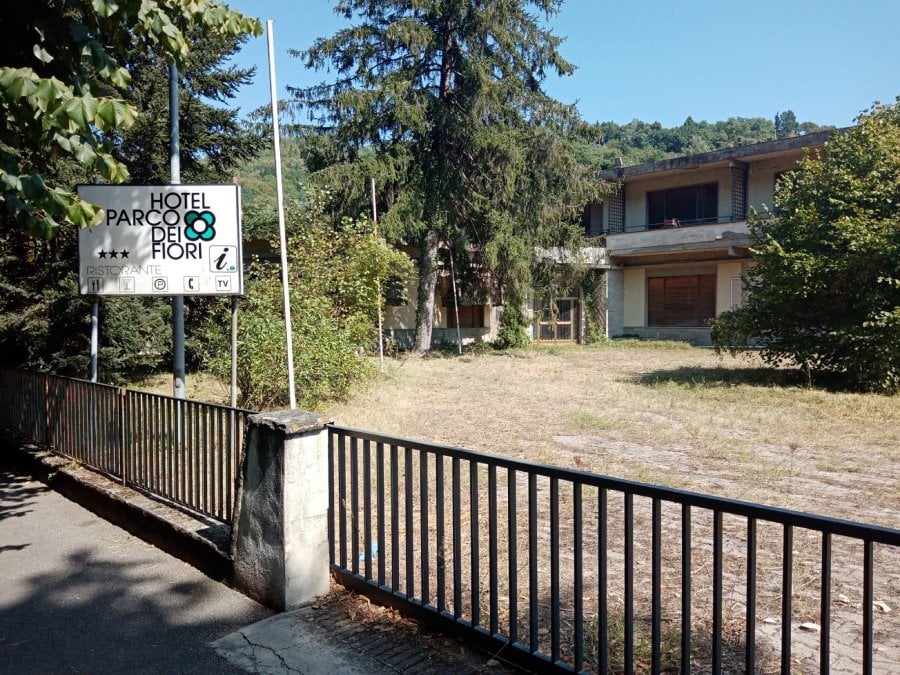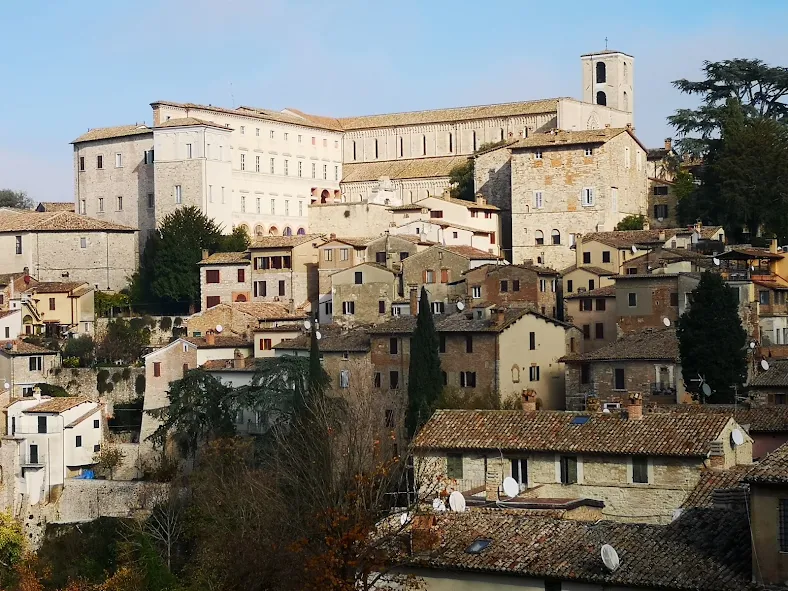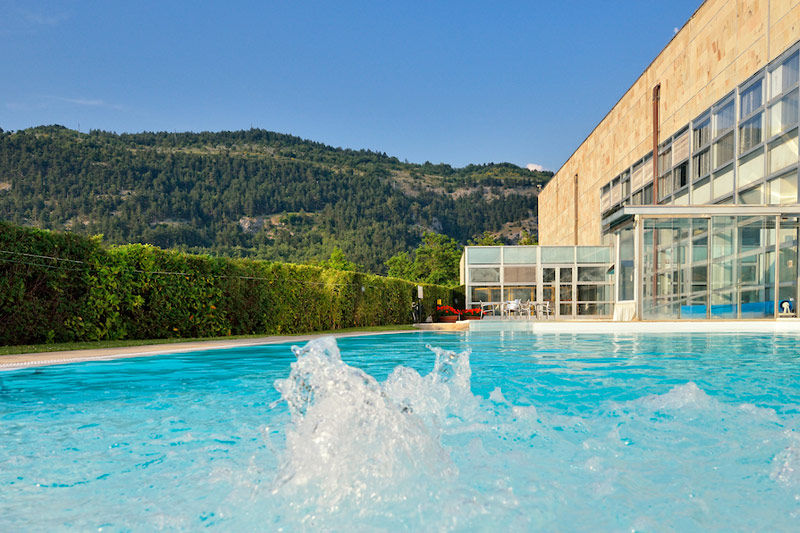
Two thermal-hospitality complexes, hotels, treatment departments, land, equipment, furnishings and a historic brand. Combined reserve prices exceed €7.5 million. Terme di Caramanico represents one of the most complex distressed hospitality opportunities currently visible in Italy. But the real investment case cannot be assessed simply by adding together property values and asking prices: the key issue is understanding exactly which rights are being acquired and how they interact with the separate concession governing the exploitation of mineral and thermal waters.
The procedure concerns assets owned by Società delle Terme Srl, within Bankruptcy Proceeding No. 65/2021 before the Court of Pescara.
The assets are being offered through two separate lots.
Key Figures
Lot 1 — Thermal and Hotel Complex
Reserve price: €3,192,124.90
Minimum offer: €2,872,912.41
Minimum bid increment: €50,000
Offer deadline: 12 October 2026, 12:00 p.m.
Sale proceedings: 13 October 2026, 12:00 p.m.
The lot includes the thermal complex, treatment areas, the hotel above it, offices, parking areas, land, furniture, equipment and the trademark:
“Terme di Caramanico – La Salute dal 1576”.
The documentation also identifies land plots associated with the presence of thermal springs.
However, physical ownership of land should not be confused with the automatic economic right to exploit the underlying water resources.
Lot 2 — Thermal and Hotel Complex, Former Wellness Centre
Reserve price: €4,329,342.07
Minimum offer: €3,896,407.86
Offer deadline: 12 October 2026, 12:00 p.m.
Sale proceedings: 13 October 2026, 12:00 p.m.
The lot includes the former wellness-centre thermal and hotel complex, adjacent or nearby land, as well as furniture and equipment serving the thermal departments, waiting areas, restaurant, kitchens and guestrooms.
The combined reserve prices exceed:
€7.52 million.
But that figure tells only part of the story.
Acquiring the Thermal Complex Does Not Automatically Mean Acquiring the Water
This is the first point investors need to understand.
In a conventional hotel investment, value is primarily driven by:
real estate + operating business + ability to generate cash flow.
In a thermal investment, a fourth variable becomes essential:
the economic right to exploit the thermal resource.
The real estate and the concession governing the exploitation of the waters must not be treated as the same asset.
The concession follows its own administrative process.
For an investor, this means separating:
Property Rights
from:
Water Exploitation Rights.
This is not merely a legal distinction.
It is an economic one.
The Valuation Equation Changes Completely
A conventional hotel can broadly be expressed as:
**Real Estate
-
Operations
= Hospitality Value**
A thermal complex requires a more sophisticated equation:
Real Estate + Hospitality + Thermal Rights + Wellness/Healthcare Operations = Investment Case
If any one of these components is unavailable, incomplete or economically misaligned with the others, the overall value can be materially impaired.
A thermal hotel without stable and economically viable access to the thermal resource may lose its principal competitive advantage.
Conversely, a water concession without appropriate operating infrastructure requires substantial real estate and operating investment.
Value therefore depends on the ability to reassemble the entire system.
The First Risk Is the Asset Perimeter
The first due diligence question should be:
what exactly am I acquiring?
For each lot, the investor needs to reconstruct precisely:
-
buildings;
-
land;
-
plant and machinery;
-
equipment;
-
furnishings;
-
parking areas;
-
trademarks;
-
ancillary rights;
-
relationship with the springs;
-
restrictions;
-
authorisations;
-
easements;
-
potentially unavailable or restricted assets;
-
infrastructure linking the different components.
A commercial description is not enough.
At Caramanico:
Legal Asset Perimeter comes before Hotel Valuation.
The Brand Creates Potential. Not Automatic Cash Flow.
Lot 1 also includes the trademark:
“Terme di Caramanico – La Salute dal 1576”.
This may represent a meaningful intangible asset.
Caramanico has a long-standing thermal tradition capable of supporting:
-
awareness;
-
heritage positioning;
-
reputation;
-
storytelling;
-
destination identity.
But the economic value of a brand does not arise from history alone.
It depends on its future ability to support:
-
demand;
-
pricing;
-
occupancy;
-
treatments;
-
wellness;
-
overnight stays;
-
F&B;
-
ancillary revenue.
A dormant heritage brand is a potential intangible asset.
It is not yet cash flow.
The Repricing of Lot 1 Is Striking. But It Is Not Enough.
The published sale history shows a substantial reduction in the reserve price of Lot 1.
The reported sequence is:
2023 — €10.53 million
2023 — €8.95 million
2023 — €8.06 million
2024 — €7.24 million
2024 — €6.52 million
2024 — €5.22 million
2025 — €4.17 million
February 2026 — €3.76 million
October 2026 — €3.19 million
From more than €10.5 million to approximately €3.2 million.
A reduction of roughly 70% compared with the first published reserve price.
That is a significant figure.
But it must be interpreted with discipline.
Price Reduction ≠ Automatic Value Creation
The purchase price may fall.
But that does not necessarily reduce:
-
CAPEX;
-
permitting complexity;
-
operating risk;
-
reopening timeline;
-
working-capital requirements;
-
execution risk;
-
commercial risk;
-
concession complexity.
The price can fall by 70%.
The underlying risk may remain almost unchanged.
Distressed Price and Investment Value Are Not the Same Thing
This is one of the most common mistakes when assessing distressed assets.
Investors compare the previous price with the current one.
They quantify the reduction.
And then conclude that a “discount” has automatically appeared.
But:
Historical Asking Price ≠ Market Value
and, more importantly:
Discount to Previous Price ≠ Investment Return.
Returns depend on the relationship between:
Total Cost Basis
and
Stabilised Value.
Not on the distance from a previous reserve price.
The Real Investment Is the Total Cost Basis
For a thermal asset, the capital requirement may materially exceed the acquisition price.
The calculation should include at least:
**Acquisition Price
-
Transaction Costs
-
Technical Due Diligence
-
Environmental Due Diligence
-
Legal & Concession Due Diligence
-
Planning Costs
-
CAPEX
-
MEP Upgrades
-
Thermal Equipment
-
FF&E
-
Pre-opening Costs
-
Working Capital
-
Financing Costs
-
Contingency**
The result is the:
Total Cost Basis
That is the capital genuinely exposed to risk.
Not the acquisition price alone.
CAPEX: The Most Important Financial Risk After Concessions
A thermal-hospitality complex is inherently capital intensive.
It is not enough to refurbish guestrooms and public areas.
Investors must assess:
-
building envelope;
-
roofing;
-
electrical systems;
-
plumbing;
-
HVAC;
-
thermal networks;
-
water conveyance systems;
-
water treatment;
-
medical and thermal equipment;
-
fire safety;
-
lifts;
-
kitchens;
-
pools;
-
wellness areas;
-
changing rooms;
-
treatment circuits;
-
energy efficiency;
-
guestrooms;
-
public areas;
-
digital infrastructure.
In a thermal complex:
CAPEX per Key is not enough.
At least two additional metrics are needed:
CAPEX per Thermal Capacity
and
CAPEX per Revenue Centre.
Because rooms, treatments, wellness, medical services and F&B operate under different economics.
Market First. Project Second.
The key question should not be:
“How do we reopen the old thermal complex?”
It should be:
“What thermal product would make economic sense in Caramanico today?”
The analysis should test at least five demand segments.
1. Traditional Thermal Healthcare
Conventional thermal treatments, including reimbursed or medically prescribed services where applicable.
2. Medical Wellness
Prevention, recovery, longevity and medical-wellness programmes.
3. Wellness Resort
Spa, leisure, wellbeing and short-break demand.
4. Nature & Thermal Retreat
Integration of thermal resources with the surrounding natural environment.
5. Integrated Destination
Hotel + thermal facilities + wellness + food + outdoor + experiences.
Maximum value may not come from recreating the historic product.
It may come from redesigning it entirely.
Caramanico Is More Than a Thermal Destination
The location creates an additional strategic advantage.
Caramanico Terme sits within the broader context of the Maiella National Park.
This creates the potential to combine:
thermal tourism + wellness + nature + hiking + food + longevity.
The destination could therefore evolve from a traditional spa town into a:
Destination Wellness Platform.
But that potential needs to be demonstrated by market evidence.
Not by narrative alone.
Two Lots: Separation or Integrated Platform?
The division into two separate lots introduces one of the most important issues in the entire investment case.
The question is not simply:
What is Lot 1 worth?
or:
What is Lot 2 worth?
The strategic question is:
what are they worth together?
The two complexes may generate:
-
economies of scale;
-
shared staffing;
-
centralised F&B;
-
integrated commercial strategy;
-
common thermal services;
-
unified marketing;
-
better purchasing terms;
-
greater investment capacity;
-
stronger brand positioning.
This means that acquiring or economically controlling both assets could theoretically create a:
Control Premium
— an additional value arising from the ability to manage the overall platform as a single system.
The Opposite Risk: Fragmentation Discount
If the two lots were acquired by different owners, inefficiencies could emerge.
For example:
-
duplicated costs;
-
internal competition;
-
difficulty sharing infrastructure;
-
access coordination issues;
-
conflicts over the use of thermal resources;
-
inconsistent branding;
-
uncoordinated CAPEX;
-
divergent commercial strategies.
This could create a:
Fragmentation Discount
— a loss of value caused not by the quality of the individual assets, but by the inability to manage the platform as a whole.
A conventional property appraisal could easily fail to capture this effect.
Control Premium vs Fragmentation Discount
An investor should therefore model at least three configurations.
Scenario 1
Acquisition of Lot 1 only.
Scenario 2
Acquisition of Lot 2 only.
Scenario 3
Coordinated economic control of both complexes.
For each scenario, the investor should compare:
-
CAPEX;
-
cost base;
-
operating synergies;
-
revenue;
-
EBITDA;
-
Debt Capacity;
-
Stabilised Value.
The value of the integrated system could be:
greater than the sum of its parts
or lower, if integration requires excessive capital expenditure.
The answer must come from the business plan.
Highest and Best Use: Thermal, Yes — But What Kind?
In a case like this, Highest and Best Use does not simply mean deciding whether the buildings should remain hospitality assets.
The question is more sophisticated:
which combination of hospitality, thermal, medical and wellness uses generates the highest sustainable value?
At least five scenarios should be compared.
Scenario A
Traditional Thermal Hotel.
Scenario B
Upscale Wellness Resort.
Scenario C
Medical Wellness & Longevity.
Scenario D
Nature & Thermal Retreat.
Scenario E
Mixed Thermal Destination with differentiated functions across the two complexes.
For each scenario, investors should model:
-
CAPEX;
-
timing;
-
pricing;
-
demand;
-
occupancy;
-
revenue mix;
-
GOP;
-
EBITDA;
-
Debt Capacity;
-
Stabilised Value.
The Business Plan Cannot Depend on Rooms Alone
A thermal hotel cannot be valued solely through:
ADR × Occupancy.
It requires a revenue-centre model.
Rooms
ADR, occupancy, RevPAR.
Thermal Treatments
Number of treatments, average ticket and daily capacity.
Wellness
Admissions, treatment revenue, membership.
F&B
Hotel guests, local demand and events.
Medical / Longevity
Services, programmes and average duration.
Ancillary Revenue
Retail, experiences, outdoor activities and events.
The more relevant KPI becomes:
Total Revenue per Guest
not simply RevPAR.
Length of Stay as a Profitability Lever
Traditional thermal tourism has historically benefited from longer stays than conventional leisure hospitality.
A modern strategy could combine:
-
therapeutic stays;
-
wellness weekends;
-
retreats;
-
medical packages;
-
short breaks;
-
corporate wellness.
Diversification may reduce seasonality.
But it also increases operational complexity.
The business plan should therefore integrate:
**Length of Stay
-
Spend per Guest
-
Customer Acquisition Cost
-
Contribution Margin.**
Stabilised EBITDA: The Number That Ultimately Determines Value
After property, springs, brand and heritage, the valuation converges on one figure:
Stabilised EBITDA.
The business plan should determine:
-
room revenue;
-
thermal revenue;
-
wellness revenue;
-
medical revenue;
-
F&B revenue;
-
ancillary revenue;
-
payroll;
-
utilities;
-
maintenance;
-
distribution;
-
marketing;
-
clinical and thermal operating costs;
-
management;
-
GOP;
-
EBITDA.
Only then can the investor calculate:
Stabilised Value.
Debt Capacity: Debt Comes After Cash Flow
The lower acquisition price may make the project appear easier to finance.
That is not necessarily the case.
Financing may need to cover:
-
acquisition;
-
redevelopment;
-
equipment;
-
pre-opening;
-
working capital.
The capital structure should therefore consider:
-
Loan to Cost;
-
Loan to Value;
-
DSCR;
-
Interest Cover;
-
cash sweep;
-
covenants;
-
stabilisation period.
The question is not:
“How much is the collateral worth?”
It is:
“How much debt can the stabilised cash flow support?”
This is the financing logic developed through Investhotel.it.
Collateral protects the lender.
Cash flow repays the debt.
Time to Market: Here, Time Destroys Value
A closed complex does not generate EBITDA.
But it continues to generate:
-
physical deterioration;
-
maintenance;
-
security costs;
-
insurance;
-
advisory costs;
-
tied-up capital;
-
interest expense;
-
progressive loss of market relevance.
For this reason:
Time = Capital Destruction.
The ability to coordinate quickly:
acquisition + concessions + design + permits + CAPEX + opening
becomes a financial variable in its own right.
Technical and Environmental Due Diligence Are Critical
The presence of springs, water networks, thermal systems and complex real estate requires a more sophisticated due diligence process than a conventional hotel.
The analysis should include at least:
-
spring characteristics;
-
abstraction systems;
-
water networks;
-
easements;
-
water quality;
-
resource availability;
-
plant and machinery;
-
discharge systems;
-
treatment systems;
-
environmental issues;
-
landscape restrictions;
-
hydrogeological restrictions;
-
structural condition;
-
regulatory compliance.
In a thermal investment:
Technical Risk can become Financial Risk directly.
The Risk of Separating Real Estate and Water Rights
This is probably the most sophisticated issue in the dossier.
If:
Real Estate Owner ≠ Water Concession Holder
an economic and legal relationship must exist between the two parties.
That relationship may determine:
-
access to the water;
-
pricing;
-
duration;
-
investment obligations;
-
maintenance;
-
exclusivity;
-
operating continuity;
-
development potential.
For the investor:
Water Rights Risk = Operating Risk.
And Operating Risk inevitably becomes:
Valuation Risk.
The Water Concession Remains a Key Investment Dependency
The water-concession process needs to be monitored separately from the sale of the real estate.
Publicly available documents have reported developments involving A.C.A. S.p.A. in house providing.
Until the concession framework is unequivocally defined, the water component should be treated as a:
Key Investment Dependency.
Not as an administrative detail.
Four Different Values That Should Never Be Confused
A professional valuation should distinguish at least four separate measures.
1. As Is Real Estate Value
What are the properties worth today in their current condition?
2. Thermal Rights Value
What economic value can be attributed to access to the thermal resource, to the extent that those rights are actually available?
3. Operating Business Value
What can the operating business be worth once reopened and productive?
4. Stabilised Destination Value
What can the overall platform be worth once it has been:
-
redeveloped;
-
reopened;
-
repositioned;
-
stabilised?
True value creation can then be expressed as:
Stabilised Value – Total Cost Basis = Development Value Creation
Do Not Buy a Thermal Complex. Buy an Economic System.
This is the central point of the entire case.
The investor should not ask only:
“How much does Terme di Caramanico cost?”
The correct question is:
Which rights am I acquiring, which rights still need to be obtained or coordinated, how much capital will be required to reopen the platform, what EBITDA can the new product generate, and what can the asset be worth once stabilised?
Until those questions are answered, the price does not define the investment.
An Integrated Analysis Through the Ecosystem
RobertoNecci.it develops the strategic perspective on the hotel industry and hospitality value creation.
InvestimentiAlberghieri.it analyses assets, redevelopment, Highest and Best Use and investment sustainability.
Investhotel.it focuses on capital structure, Debt Capacity, DSCR and the relationship between cash flow and financing.
HotelControl.it analyses KPIs, cost structures and operating performance.
HotelIntelligence.it integrates data, market intelligence and decision support.
HotelMarketingLab.it analyses positioning, distribution and demand-generation capabilities.
HotelManagementGroup.it focuses on operating models, organisation and execution.
A project such as Caramanico requires precisely this type of multidisciplinary analysis:
real estate + legal + concessions + hospitality + wellness + finance + operations + market.
The 15 Questions to Answer Before Investing
1.
What is the exact perimeter of each lot?
2.
Which plots contain or serve the thermal springs?
3.
Which assets are subject to restrictions or unavailability?
4.
What is the current status of the regional water concession?
5.
Which water rights would the buyer actually obtain?
6.
How much CAPEX does each complex require?
7.
How much CAPEX is specifically related to thermal infrastructure?
8.
Is there a Control Premium from acquiring or economically controlling both lots?
9.
What Fragmentation Discount could arise under separate ownership?
10.
What is the Highest and Best Use?
11.
What thermal, medical and wellness demand can realistically be captured?
12.
How much revenue can each revenue centre generate?
13.
What is the Stabilised EBITDA?
14.
What Debt Capacity can the project support?
15.
What is the Stabilised Value of the integrated platform?
Without answers to these questions:
€7.52 million is simply the sum of two reserve prices.
It is not yet the value of the investment.
The Caramanico Investment Equation
The dossier can be summarised as follows:
**Real Estate
-
Thermal Infrastructure
-
Water Rights
-
Brand
-
Control Premium
-
Hospitality Operations
-
Wellness & Medical Potential
– CAPEX
– Fragmentation Risk
– Execution Risk
– Time to Market
= Investment Case**
That is the equation investors need to solve.
Conclusion
Terme di Caramanico is one of the most compelling distressed hospitality cases in Italy because value is not concentrated in a single property.
It is distributed across:
real estate, hotels, thermal infrastructure, land, brand, springs, concessions, governance and future operating capacity.
Repricing may attract investors.
But it does not automatically eliminate risk.
Heritage creates identity.
Water creates differentiation.
Real estate creates productive capacity.
Management creates cash flow.
Integrated control may create synergies.
But only:
clear rights + sustainable CAPEX + economic control + demand + management + finance
can transform those elements into value.
In distressed hospitality, price can fall far faster than risk.
At Caramanico, the real question is not what the properties cost today.
It is:
how much capital is required to transform Caramanico once again into a thermal platform capable of generating EBITDA and long-term value?
At Caramanico, investors are not simply buying thermal real estate. They are attempting to rebuild an economic platform in which property, water, concessions, CAPEX and management must once again work together to create value.
CTA — The Dossier Comes Before the Bid
Are you assessing:
-
hotels;
-
resorts;
-
thermal complexes;
-
distressed real estate;
-
conversion opportunities;
-
assets in liquidation;
-
redevelopment projects?
InvestimentiAlberghieri.it provides independent preliminary analysis before capital-allocation decisions are made.
We assess:
-
asset perimeter;
-
Highest and Best Use;
-
CAPEX;
-
Total Cost Basis;
-
Control Premium;
-
Fragmentation Discount;
-
business plan;
-
Stabilised EBITDA;
-
Debt Capacity;
-
DSCR;
-
operating scenarios;
-
downside case;
-
Stabilised Value;
-
Exit Value.
We do not intermediate the purchase price. We analyse the value and economic sustainability of the investment case.
For enquiries:
info@investimentialberghieri.it
Methodological Note
This article is based on publicly available information relating to Bankruptcy Proceeding No. 65/2021 before the Court of Pescara and on documentation concerning the separate procedure for the award of the concession to exploit the mineral, thermal and spring waters of Caramanico Terme.
For Lot 1, the published documentation states a reserve price of €3,192,124.90, a minimum offer of €2,872,912.41, an offer deadline of 12 October 2026 at 12:00 p.m., and sale proceedings beginning on 13 October 2026 at 12:00 p.m.
For Lot 2, the sources reviewed report a reserve price of €4,329,342.07, a minimum offer of €3,896,407.86, the same offer deadline and sale proceedings beginning on 13 October 2026.
The presence of land associated with thermal springs within the real estate perimeter should not be interpreted as automatically granting the buyer all economic exploitation rights over the waters.
The water concession is subject to a separate regional administrative process.
Any investment decision therefore requires a complete review of the sale notices, appraisal reports, procedural documents, concession framework, technical documentation, planning status, environmental matters, tax position and financing structure.
The economic and strategic scenarios discussed in this article are methodological in nature and do not constitute a valuation of the assets, concession rights or expected outcome of the transaction.