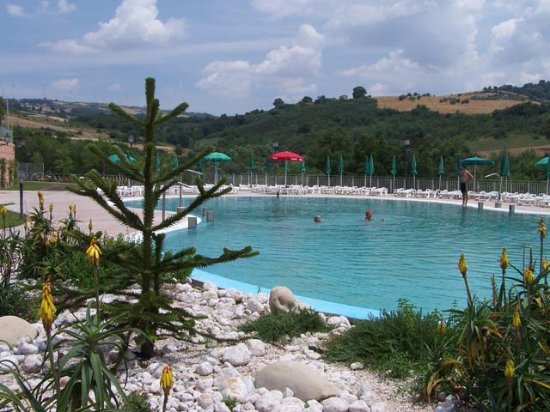
From €13.67 million to €3.24 million across six auction rounds. The thermal hospitality complex in Villamaina, in the province of Avellino, will return to auction on 25 November 2026, with a minimum admissible bid of €2.43 million. The repricing is striking, but for a professional investor the discount is not the answer. It is merely the starting point of the underwriting process.
A hospitality asset whose asking price falls from €13.67 million to €3.24 million will inevitably attract attention.
But the wrong question would be:
“How far has the price fallen?”
The right question is:
“At what Total Investment Cost can this property be brought back into operation, and what stabilized EBITDA can it realistically generate?”
This is the framework through which the forthcoming auction of the thermal hospitality complex in Villamaina, in the province of Avellino, should be assessed.
The property is being sold as part of Enforcement Proceeding No. 16/2023 before the Court of Avellino.
The new auction is scheduled for 25 November 2026 at 10:00 a.m.
Key Auction Figures
-
Base price: €3,243,447.21
-
Minimum admissible bid: €2,432,585.41
-
Minimum bid increment: €25,000
-
Bid submission deadline: 24 November 2026 at 12:00 noon
-
Sale: without auctioneer-led bidding
-
Procedure: synchronous sale
-
Proceeding: Real Estate Enforcement No. 16/2023
-
Court: Avellino
-
Lot: single lot
-
Occupancy status: reported as vacant
The property is described as a thermal tourism and hospitality complex comprising outdoor thermal pools, mud-therapy facilities, a spa, food and beverage operations, landscaped grounds, land and sulphurous-water springs.
This is therefore not simply the sale of a hotel.
It is a hospitality special situation with a thermal component, where real estate, hotel operations, wellness, plant and equipment, and regulatory matters must all be assessed simultaneously.
From €13.67 Million to €3.24 Million
The auction history is probably the figure that makes the opportunity immediately stand out.
| Auction date | Base price |
|---|---|
| 22 May 2024 | €13,667,859.88 |
| 11 October 2024 | €10,250,894.91 |
| 28 February 2025 | €7,688,171.18 |
| 24 September 2025 | €5,766,128.38 |
| 12 June 2026 | €4,324,596.28 |
| 25 November 2026 | €3,243,447.21 |
The base price has therefore fallen by approximately 76% compared with the first auction round.
Even more striking is the comparison with the current minimum admissible bid of €2.43 million, which is more than 82% below the original base price.
The previous auction on 12 June 2026, at a base price of €4.32 million, received no bids.
The forthcoming round therefore incorporates a further 25% reduction.
At first glance, this may appear to be the point at which “the price has finally become attractive.”
In distressed hospitality, however, that conclusion can be dangerously simplistic.
Judicial Price Does Not Equal Investment Value
The price generated through successive judicial auction rounds is one thing.
The industrial and investment value of the hospitality asset is another.
An asset can fall 80% from its original auction price and still be too expensive.
Alternatively, it may become an exceptionally compelling opportunity.
Everything depends on what happens after acquisition.
The appropriate equation is therefore not:
Value = Acquisition Price
but rather:
Total Investment Cost = Acquisition + Transaction Costs + CAPEX + FF&E + Pre-opening + Working Capital + Financing Costs
Total Investment Cost must then be assessed against:
Stabilized EBITDA + Exit Value + Target IRR
That is the real underwriting exercise.
At InvestimentiAlberghieri.it, hospitality opportunities are analysed precisely from this perspective: a low acquisition price does not automatically translate into an attractive investment.
A Cheap Price Is Not Necessarily a Cheap Investment
Assume, purely for illustrative purposes, that an investor succeeds in acquiring the complex at or close to the €2.43 million minimum bid.
That amount may represent only a fraction of the capital ultimately required.
The investor would also need to consider:
-
transaction costs;
-
technical remediation;
-
building services and systems;
-
potential energy-efficiency upgrades;
-
swimming pools and thermal facilities;
-
spa and wellness areas;
-
guestrooms and public spaces;
-
kitchens and F&B facilities;
-
FF&E;
-
technology systems;
-
pre-opening expenses;
-
launch marketing;
-
working capital;
-
financing costs during the repositioning period.
If, for example, the project required a further €5-7 million of investment, this would no longer be a €2.43 million acquisition.
It would become a €7.5-10 million-plus investment project.
Returns would need to be assessed against that amount.
The auction price is therefore the entry price.
Total Investment Cost is the true cost of the investment.
The Sensitivity Analysis Every Investor Should Build
Before submitting a bid, an investor should develop at least a sensitivity matrix comparing Total Investment Cost with stabilized EBITDA.
For purely illustrative purposes:
| Total Investment Cost | €0.8M EBITDA | €1.0M EBITDA | €1.2M EBITDA |
|---|---|---|---|
| €6 million | 13.3% | 16.7% | 20.0% |
| €8 million | 10.0% | 12.5% | 15.0% |
| €10 million | 8.0% | 10.0% | 12.0% |
These figures represent a simple EBITDA Yield on Cost and should not be interpreted as a forecast for the Villamaina property.
They do, however, demonstrate why CAPEX is critical.
If the all-in investment rises rapidly while achievable EBITDA remains constrained, the discount obtained at auction becomes progressively less relevant.
Conversely, if the asset can be successfully repositioned and achieve profitability consistent with the overall capital invested, judicial repricing may create a genuine investment opportunity.
The Strategic Question: Local Thermal Hotel or Destination Wellness Resort?
The second major decision concerns the concept.
Villamaina does not benefit from the level of spontaneous demand associated with major Italian destinations such as Rome, Milan, Florence or Venice.
The project therefore cannot necessarily be underwritten as a conventional hotel.
The property itself may need to become a demand generator.
At least three strategic scenarios can be considered.
1. Conservative Reopening
Reopening the property with essential works only, maintaining a predominantly local and regional market positioning.
Advantage: lower CAPEX.
Risk: limited ability to achieve an ADR and occupancy level sufficient to generate an adequate return on invested capital.
2. Thermal Repositioning
A more substantial refurbishment of the hotel and wellness facilities, combined with a new positioning strategy, higher product quality and a broader national commercial approach.
The required investment increases, but so does the potential addressable demand.
3. Destination Wellness Resort
This is the most ambitious industrial scenario.
The property would be repositioned as a destination where:
hospitality + thermal treatments + wellness + medical wellness + food + nature + experiences
combine to create a single integrated product.
Under this scenario, Villamaina would no longer compete solely with hotels in the province of Avellino.
Its competitive set would shift towards Italian thermal and wellness resorts.
This fundamentally changes the investment thesis.
The objective would no longer be to sell a room to guests who already need to travel to Villamaina.
The objective would be to persuade guests to travel to Villamaina specifically because of the resort.
The Thermal Springs Could Be the Asset’s Key Differentiator
The documentation refers to the presence of sulphurous-water springs.
Potentially, this is one of the most attractive features of the entire investment.
It is also one of the areas in which superficial due diligence could be particularly risky.
Establishing that a spring physically exists is not enough.
An investor would need to verify:
-
ownership and usage rights;
-
concessions;
-
regulatory approvals;
-
duration of existing permits;
-
renewal requirements;
-
water characteristics;
-
available flow rates;
-
permitted uses;
-
healthcare and sanitary regulations;
-
potential restrictions;
-
transferability of rights following judicial acquisition;
-
capital expenditure required to exploit the resource commercially.
A significant portion of the strategic value of the entire asset may depend on these issues.
Certain Elements in the Documentation Deserve Particular Attention
Documents relating to previous auction rounds also highlighted several matters that investors should reconfirm carefully against the latest available court documentation.
These included references to certain ancillary structures that had not been regularized and the absence, within municipal records, of some drawings relating to extensions of the property.
Earlier documentation also referred to furniture and equipment excluded from the sale, as well as special waste located in outdoor areas, whose removal was expected to be undertaken by the enforcing creditor.
This does not necessarily mean that these matters remain unresolved today.
It does mean, however, that they should form part of the investor’s due diligence checklist.
In judicial acquisitions, value is not determined solely by what is being purchased.
It also depends on the investor’s ability to identify, quantify and price all the issues that may need to be resolved following acquisition.
The Seven Due Diligence Workstreams Required
A professional investment process for Villamaina should therefore address at least seven parallel workstreams.
1. Legal Due Diligence
Title, easements, encumbrances, transfer mechanics, effects of judicial adjudication and the specific conditions governing the sale.
2. Urban Planning & Cadastral Due Diligence
Planning and cadastral compliance, extensions, permits, potential regularization requirements and redevelopment possibilities.
3. Technical Due Diligence
Structure, building services, fire compliance, swimming pools, heating systems, water-treatment systems, energy efficiency and deferred maintenance.
4. Thermal & Regulatory Due Diligence
Rights over the springs, concessions, permits, water characteristics and the ability to exploit the thermal resource commercially.
5. Hotel Product Due Diligence
Guestrooms, dimensions, layouts, services, spa, F&B, customer journey and alignment between the physical product and the intended market positioning.
6. Commercial Due Diligence
Demand generators, catchment area, competitors, achievable ADR, occupancy, seasonality, distribution channels and customer segmentation.
7. Financial Underwriting
Acquisition cost, CAPEX, FF&E, working capital, stabilized EBITDA, cash flow, break-even, DSCR, debt capacity, IRR and exit value.
Only by integrating these seven analyses can an investor establish whether €2.43 million represents an opportunity or simply the first instalment of a much larger investment requirement.
The Business Plan Must Start with EBITDA, Not Square Metres
A hotel cannot be valued solely by applying a price per square metre.
Its value is fundamentally linked to its ability to generate sustainable operating income.
For Villamaina, the underwriting should distinguish between at least three principal revenue centres.
Rooms
-
number of saleable guestrooms;
-
stabilized occupancy;
-
ADR;
-
RevPAR;
-
customer segmentation;
-
seasonality.
Thermal & Wellness
-
external day visitors;
-
treatments;
-
spa usage;
-
wellness programmes;
-
accommodation packages;
-
medical wellness;
-
memberships;
-
day-use customers.
Food & Beverage
-
restaurant operations;
-
breakfast;
-
banqueting;
-
events;
-
local customers;
-
potential destination dining.
These revenues must then be assessed against a cost structure that may be materially higher than that of a conventional hotel.
Particular attention should be paid to:
labour, energy, swimming pools, maintenance, water treatment, technical systems and wellness operations.
The objective is to determine a normalized and sustainable EBITDA.
Only then does it become possible to discuss value.
Real Estate and Hotel Business Are Not the Same Thing
Another fundamental distinction concerns operations.
Acquiring the property does not automatically mean acquiring a functioning hotel business.
Following adjudication, the investor will still need:
-
an operating organization;
-
management;
-
staff;
-
a PMS;
-
revenue management;
-
distribution;
-
marketing;
-
operating procedures;
-
management control systems;
-
brand strategy;
-
sales capabilities;
-
a pre-opening plan.
The operating model should therefore be determined before the investment is completed.
Possible alternatives include:
direct management, management agreement, lease, business lease or the appointment of a specialist operator.
HotelManagementGroup.it focuses precisely on the operational issues involved in turnaround situations, organizational restructuring and the management of hospitality assets requiring repositioning.
Investhotel.it focuses on extraordinary transactions, acquisitions, distressed hospitality and turnaround strategies.
Where the Value Could Be Created
The real investment thesis for Villamaina should therefore not be:
“Buy for €2.43 million something that was once offered for €13.67 million.”
That would be a purely real-estate interpretation.
The correct thesis should be:
“Acquire the asset at a sufficiently low entry price to absorb CAPEX, repositioning and turnaround costs while keeping Total Investment Cost below the stabilized value of the property.”
The distinction is fundamental.
Any value creation would potentially come from:
Entry Discount
Operational Turnaround
Repositioning
EBITDA Growth
Yield Compression / Exit Multiple Expansion
It is precisely this combination that can transform a distressed asset into a genuine special situation.
The Real Question Ahead of the 25 November Auction
On 25 November 2026, the market will not simply be deciding the current value of a real-estate complex in Villamaina.
It will be deciding how much capital can rationally be invested to transform that property into an economically sustainable hospitality business.
The repricing from €13.67 million to €3.24 million has removed a very substantial part of the previous acquisition price.
It has not removed the operating risk.
It may simply have reduced the entry price sufficiently for that risk to become investable.
That is the key distinction.
Cheap price ≠ cheap investment.
Distressed price + disciplined CAPEX + sustainable EBITDA = potential investment opportunity.
Any investment decision should ultimately be based on that equation.
Conclusions
Villamaina is an excellent case study in how a hotel auction should be analysed.
The headline numbers are straightforward:
€13.67 million in 2024.
€3.24 million today.
€2.43 million minimum admissible bid.
The financial analysis is far more complex.
An investor must establish:
-
how much CAPEX is required;
-
what rights are actually attached to the thermal-water resources;
-
which concept can support the location;
-
how much demand the property can generate;
-
what stabilized EBITDA the resort could achieve;
-
what financing structure the project can support;
-
what the asset may ultimately be worth once stabilized.
Only once these questions have been answered can an investor determine whether the substantial judicial repricing has genuinely created an opportunity.
The hospitality special situations market does not necessarily reward the investor who buys at the lowest price.
It rewards the investor who is best able to understand, before everyone else, what the hotel can be worth once its problems have been resolved.
At RobertoNecci.it, we explore hospitality strategy, valuation and governance; Investhotel.it focuses on extraordinary transactions and distressed situations; HotelManagementGroup.it addresses hotel operations, turnaround and performance; while InvestimentiAlberghieri.it monitors and analyses investment opportunities across the Italian hospitality real-estate market.
Are You Assessing a Hotel Auction or a Hospitality Special Situation?
Before submitting a bid, it is essential to establish not only what it costs to acquire the asset, but more importantly:
how much capital it requires, what EBITDA it can generate and what value it could reach following turnaround and stabilization.
For preliminary investment analysis, hotel due diligence and valuation assignments:
info@investimentialberghieri.it