A feasibility analysis of Ernesto Basile’s historic villa on Via Abruzzi
Bottom line first: as a stand-alone hotel acquired at prevailing market values and fully converted at the investor’s expense, an asset of this kind would struggle to generate returns consistent with a professionally underwritten hotel investment. The project can make sense, but only under three specific configurations. The issue is not the building’s hospitality potential. It is scale, capital structure and cost per key.
Among the assignments I have worked on over the years, one asset class comes up repeatedly: the historic villa in central Rome, architecturally significant and often protected, where an owner, investor or adviser wants to understand whether the property could be converted into a high-end hospitality asset.
At first sight, it sounds like a simple question.
In reality, the answer depends on at least six variables:
-
the gross area that can actually be converted;
-
the number of keys that can realistically be created;
-
architectural and planning constraints;
-
conversion capex;
-
achievable hotel performance;
-
the ownership and contractual structure of the transaction.
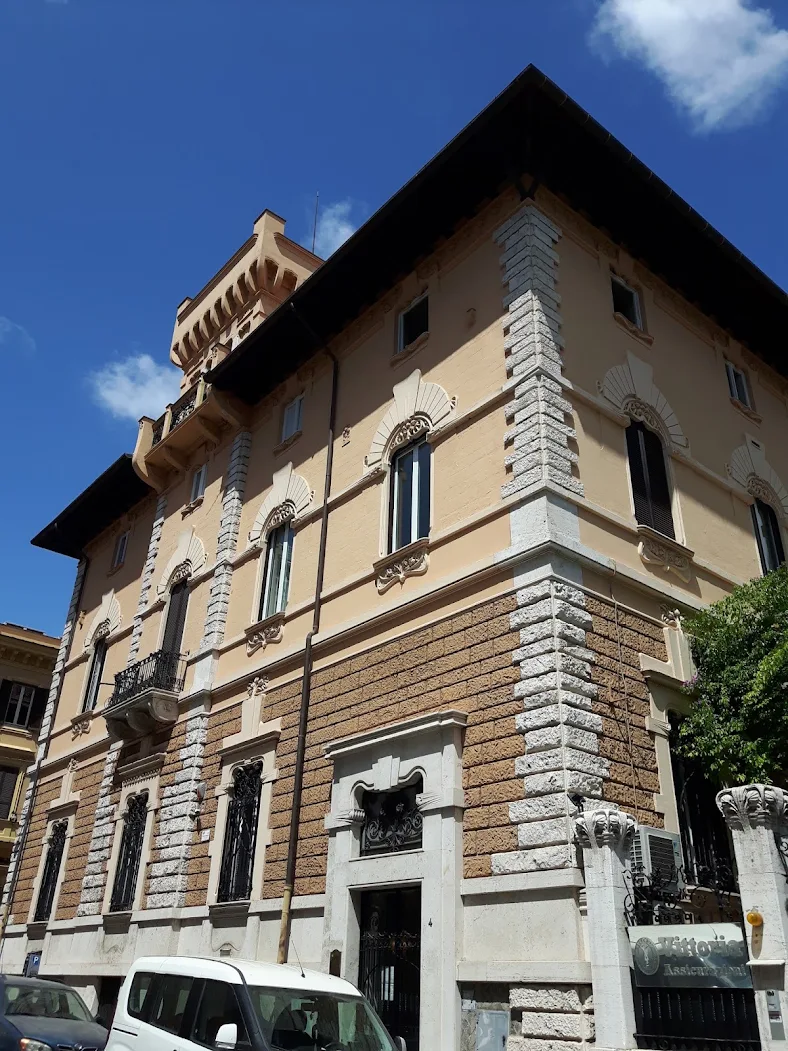
Villino Florio on Via Abruzzi is an excellent case study because it shows why, when looking at an exceptional building, the question “Could this become a hotel?” is not the same as asking “Should this become a hotel?”
Those are two very different analyses.
The asset
Villino Florio stands on Via Abruzzi in Rome and was designed in 1902 by Ernesto Basile and Carlo Pincherle for the Florio family.
Between 1900 and 1914, Rome saw the construction of numerous villas inspired by European Liberty architecture, tempered by the influence of the Italian classical tradition.
Ernesto Basile and Carlo Pincherle were two prominent figures of that period.
Basile, born in Palermo in 1857, also worked in Rome for several years, where he was involved in the creation of the new parliamentary chamber at Palazzo Montecitorio. In Palermo, his works included the Teatro Massimo, Villa Florio and Villa Igiea.
That last reference is particularly relevant from a hospitality perspective.
Ignazio Florio Jr., one of the leading Italian entrepreneurs of his generation, inherited a vast business empire spanning shipping, tuna fisheries, salt works, foundries and wine production.
In 1893, he married Donna Franca Jacona della Motta di San Giuliano.
Together, they became one of the most celebrated couples of Europe’s Belle Époque. Monarchs, aristocrats, artists and intellectuals frequented their residences. Gabriele D’Annunzio celebrated Donna Franca, Giovanni Boldini painted her portrait, and leading Parisian jewellers and fashion houses worked for her.
During their stays in Rome, partly connected with Ignazio Florio’s business and institutional interests, the family used the villa on Via Abruzzi.
The Florio family’s economic fortunes changed dramatically after the First World War. Their businesses gradually fell into crisis, assets were sold and much of the family fortune was eventually lost.
Yet for anyone studying hotel real estate, the architectural parallel remains compelling.
The same architectural culture that produced Villino Florio also contributed to Villa Igiea in Palermo, a private residence that evolved into one of the landmark hotels of Italian luxury hospitality.
So the precedent exists.
But the fact that a building is extraordinary does not automatically mean that converting it into a hotel creates value.
The first question: how many keys can you actually create?
The first question is not ADR.
It is not the brand.
It is not even the interior design concept.
It is the number of rooms.
The property comprises two main above-ground floors, together with a basement level, attic, tower and rear garden.
Based on publicly available information, a preliminary estimate of gross floor area could reasonably fall within the region of 1,000-1,200 square metres, although this would of course need to be confirmed through cadastral documentation, measured surveys and technical due diligence.
In a building without major design constraints, a luxury hotel may sometimes achieve gross-area ratios of approximately 45-50 square metres per key.
A historic building is different.
Existing staircases, structural walls, original layouts, reception rooms, vertical circulation, decorative features and inefficient spaces materially increase the gross-area requirement per room.
For a property with these characteristics, I would consider a preliminary ratio of approximately:
60-70 gross sqm per key.
That produces an indicative room count of:
14-18 keys
This number determines almost everything that follows.
And this is where the central issue emerges.
Below twenty rooms, an independent full-service hotel enters an extremely challenging operating zone.
Reception, housekeeping, maintenance, administration, security, technology, distribution, sales and management costs do not fall in direct proportion to room count.
Many of those costs are semi-fixed.
Adding services does not necessarily solve the problem either.
A restaurant, spa or meeting space may improve the commercial proposition, but in an asset this small they can also increase operating complexity and cost faster than they increase revenue.
The operating model
For illustrative purposes, assume a 16-key configuration, positioned in the luxury segment and located within the Ludovisi-Via Veneto area.
This is not the absolute prime micro-location of Piazza di Spagna, the Pantheon or certain parts of Rome’s historic centre, but it is unquestionably one of the city’s most prestigious and internationally recognisable hospitality districts.
A preliminary operating scenario could look as follows:
| Metric | Assumption |
|---|---|
| Keys | 16 |
| ADR | €550-650 |
| Occupancy | 65-70% |
| RevPAR | approx. €400 |
| Rooms revenue | approx. €2.3m |
| Total revenue | approx. €2.6m |
| GOP margin | 30-33% |
| GOP | approx. €800k-850k |
In absolute terms, that is a respectable operating result.
The problem appears when it is measured against the capital required to create the hotel.
What could the transaction cost?
For a high-quality property in this part of Rome, a preliminary analysis might work with real estate values in the range of:
€12,000-15,000 per sqm
For an asset with these particular characteristics, applying values consistent with location, architectural quality, condition and effectively marketable area could lead to an indicative property value in the region of:
€13-16 million.
Then comes the conversion cost.
Converting a historic building into a luxury hotel is fundamentally different from renovating a conventional property.
A hotel requires specialist MEP systems, fire compartmentation, life-safety systems, air-conditioning, lifts and vertical circulation, service areas, bathrooms, acoustic treatment, technology, FF&E, structural works and regulatory upgrades.
Where the building has significant architectural value, existing decorative and historic elements must also be protected and integrated into the project.
For an initial feasibility exercise, one could therefore test a capex assumption in the range of:
€10,000-15,000 per sqm
Using reasoned assumptions rather than simply multiplying the mathematical extremes of the ranges, total conversion capex could plausibly fall in the region of:
€12-16 million.
Total project cost could therefore reach:
€28-30 million
to generate a GOP of approximately:
€800k-850k
That implies an operating yield on total investment below 3%, even before financing costs, taxes, corporate overheads, FF&E reserves and other below-GOP items are taken into account.
For a hotel investor targeting institutional-style returns, that is an extremely difficult equation.
Debt-service capacity would be limited and the project’s bankability would require very careful scrutiny.
The real issue: cost per key
The clearest way to understand the problem is to divide total investment by room count.
With an investment of roughly €28-30 million and 16 rooms, total cost could exceed:
€1.7 million per key
That is extremely difficult to justify through hotel operations alone.
Even assuming a strong stabilised exit value per room, the finished hotel would struggle to compensate automatically for the combined weight of:
real estate acquisition + capex + financing costs + planning risk + operating risk.
Under the assumptions considered here, the conversion could therefore create one of the most important problems in hotel real estate:
it could destroy value rather than create it.
The property’s highest and best use could therefore remain an ultra-prime private residence, a representative corporate headquarters or another use capable of preserving the asset’s intrinsic value without imposing the cost structure of a hotel.
Constraints can make the economics even more challenging
A serious feasibility study should assess at least three areas of risk before any final business plan is prepared.
1. Architectural protection
The exact protection regime affecting the property must be verified, including any restrictions arising from Rome’s planning framework, the Carta per la Qualità, Legislative Decree 42/2004 and any other applicable heritage regulations.
Friezes, the tower, cornices, ironwork, gates, decorative interiors, staircases and existing spatial arrangements can materially limit design flexibility.
For a hotel, the economic effect is very simple:
less design flexibility = more square metres per key = fewer rooms = lower potential revenue.
2. Change of use
The conversion from residential to hotel use within Rome’s historic urban fabric must be assessed from a planning, building-regulation and administrative perspective.
Among other matters, the analysis should address:
-
whether the proposed change of use is permitted;
-
any increase in planning load;
-
applicable planning standards;
-
parking requirements and potential monetisation mechanisms;
-
construction contributions and municipal charges;
-
health and hygiene requirements;
-
fire safety;
-
accessibility;
-
regional hotel regulations.
This can represent one of the most significant risks in the entire transaction.
For that reason, a technical and planning pre-feasibility study should ideally be completed before the property is acquired.
3. Hotel operations
A building may be technically convertible and still be operationally inefficient.
The feasibility study should therefore test:
-
back-of-house capacity;
-
staff access;
-
deliveries and loading;
-
storage;
-
laundry logistics;
-
housekeeping;
-
food and beverage;
-
waste management;
-
plant and equipment;
-
staffing;
-
safety;
-
guest and staff circulation.
In a small building, every square metre allocated to support functions is a square metre that cannot produce room revenue.
That competition between revenue-generating space and operational space is one of the reasons boutique hotels in historic buildings are so difficult to underwrite correctly.
Architectural beauty is an ADR multiplier, not a feasibility multiplier
This may be the most important principle in the entire analysis.
An exceptional property can undoubtedly support a higher ADR.
But while architectural quality may increase revenue per room by a percentage, it can increase cost per room by a multiple.
That is precisely where projects that appear irresistible at an emotional level can become economically fragile.
The three configurations in which the project could work
Saying that the stand-alone acquisition model is weak does not mean that the building has no hospitality potential.
It means that the transaction structure has to change.
1. Lease or another structure without acquiring the real estate
If the owner retains ownership of the property and makes it available to an operator through a lease or another suitable contractual structure, the economics change substantially.
A purely indicative rent assumption might fall, depending on the terms of the transaction, in the region of:
€250k-350k per year.
Under this structure, the operator no longer needs to remunerate the full acquisition value of the real estate.
The capex question still has to be solved, of course.
It could be:
-
fully funded by the owner;
-
fully funded by the tenant/operator;
-
shared between the parties;
-
recovered through rent-free periods or other contractual mechanisms.
This is potentially one of the most realistic structures.
2. Annex or suite wing to an existing five-star hotel
This may be the most compelling industrial solution.
The 14-18 rooms could operate as an annex, private residence, suite wing or satellite building of an established luxury hotel already operating in the Via Veneto-Ludovisi district.
The rooms could then leverage the existing hotel’s:
-
reception;
-
property-management systems;
-
revenue management;
-
distribution;
-
sales;
-
administration;
-
housekeeping management;
-
food and beverage;
-
engineering;
-
management team.
The scale problem would therefore be partially neutralised.
Instead of operating as a small hotel with its own fixed-cost structure, the property would become a highly differentiated inventory extension within an existing operating platform.
For a hotel group already established in the area, this could be the scenario with the greatest strategic value.
3. Serviced apartments or a managed residential model
The third option is not to force the building into a traditional hotel model.
A serviced-apartment, managed-residence or light-touch hospitality concept, where permitted under the relevant planning framework, could offer:
-
lower staffing intensity;
-
less back-of-house space;
-
limited F&B complexity;
-
longer stays;
-
lower housekeeping frequency;
-
a simpler operating model.
ADR might be lower than in a traditional luxury hotel.
But absolute ADR is not what ultimately matters.
What matters is the margin generated relative to invested capital.
For protected assets with fewer than twenty units, this can often be economically more rational than a conventional full-service hotel.
What sub-20-key luxury hotels really teach us
Outstanding hotels with fewer than twenty rooms certainly exist.
Some achieve exceptional ADRs.
But successful economics usually depend on at least one of the following conditions:
-
the real estate was acquired historically at a very low basis;
-
the property was already owned before conversion;
-
there is little or no material debt;
-
the ownership structure is family-based;
-
services are shared with another property;
-
the positioning is genuinely ultra-luxury;
-
F&B is independently profitable;
-
the underlying real estate retains substantial value regardless of hotel performance.
Room count should therefore never be analysed in isolation.
It must be assessed together with the capital structure of the investment.
What the Villino Florio case really teaches us
Villino Florio illustrates one of the fundamental principles of hotel investment.
The first question should not be:
“Wouldn’t this make a beautiful hotel?”
The correct sequence is:
How many square metres can actually be converted?
How many keys can realistically be created?
What is the total cost per key?
What ADR can the product genuinely sustain?
What occupancy can it achieve?
What GOP can it generate?
How much capital is required?
Which ownership or contractual structure makes the transaction sustainable?
What is the value of the stabilised asset?
Only after answering those questions does it make sense to discuss concept, interior design, branding and operators.
This is the framework I have applied over the years to more than 150 hotel projects and transactions.
Before acquiring a property for hotel conversion, you need to know whether the hotel will create value
One of the most expensive mistakes in hotel real estate is to acquire the property first and investigate the feasibility of conversion afterwards.
The sequence should be the exact opposite.
For owners, investors, family offices, funds, lenders, law firms, real estate advisers and operators considering the acquisition or conversion of a property into a hotel, I can prepare a preliminary feasibility assessment covering:
-
property size and usable area;
-
estimated number of keys;
-
market positioning;
-
ADR and occupancy assumptions;
-
hotel operating model;
-
GOP projections;
-
cost-per-key analysis;
-
preliminary capex assessment;
-
alternative-use scenarios;
-
lease, management or ownership structures;
-
comparison between stand-alone, management and lease models;
-
support for a go / no-go investment decision.
The objective is not to prove that a building can become a hotel.
The objective is to determine whether it should.
For an initial assessment of a property or hotel-conversion opportunity:
Further insights:
-
Roberto Necci — advisory, methodology, publications and professional activity
-
Investimenti Alberghieri — hotel investment analysis, market intelligence and deal coverage
-
Investhotel — hotel transactions, M&A and transaction advisory
-
Hotel Marketing Lab — hotel positioning, marketing and commercial development
-
Necci Hotels — hotel management and development
-
Vertex Executive Search — executive search for hospitality management positions
-
Roberto Necci Academy — hospitality management education and executive training
-
Hotel Management Group — hotel management, advisory, development and repositioning
Methodological note
The estimates regarding floor area, room count, ADR, occupancy, revenue, capex, real estate values and operating results included in this article are preliminary calculations prepared by the author on the basis of publicly available information and general market parameters.
They do not constitute a formal appraisal, property valuation, fairness opinion, offer, investment solicitation, technical assessment or planning opinion concerning the asset.
Nor do they imply any professional mandate, relationship or communication with the owner of the property mentioned, and no statement or assumption is made regarding any intention by the owner to sell, lease, convert or otherwise reposition the property.
Any investment decision should be preceded by asset-specific technical, planning, legal, tax, financial and commercial due diligence.