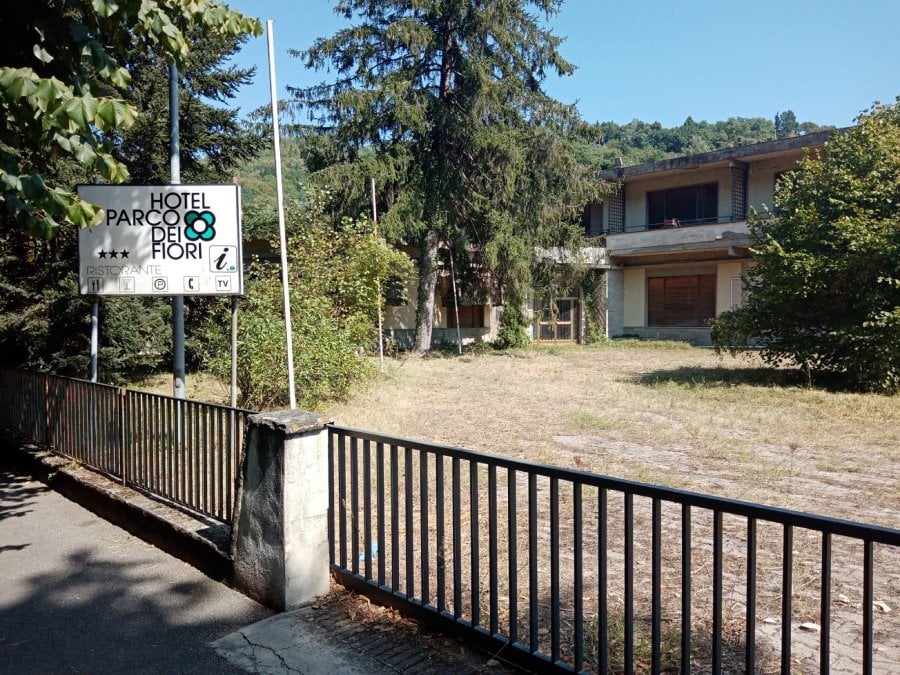
Twenty-seven en-suite rooms, a restaurant, bar, banqueting hall, ballroom, terrace and more than 5,600 square metres of parkland. Reserve price: €515,000. The former Hotel Parco dei Fiori in Ronta, in Tuscany’s Mugello area, is returning to the market through a competitive sale process. But the headline figure risks distracting investors from the only question that really matters: is hospitality still the Highest and Best Use of the asset?
In hospitality real estate, a low purchase price does not automatically represent an opportunity.
It may be one.
But it may equally represent nothing more than the entry price into a transaction requiring substantially more capital than the amount needed to acquire the property.
That is the first point to consider when assessing the former Hotel Parco dei Fiori, located at 72 Via Faentina in Ronta, within the municipality of Borgo San Lorenzo.
The sale documentation indicates a reserve price of €515,000, with a minimum bidding increment of €5,000.
The competitive sale is scheduled for 24 November 2026 at 12:00 p.m., while offers must be submitted by 12:00 p.m. on 23 November.
The property includes:
-
7 en-suite rooms on the ground floor;
-
20 en-suite rooms on the first floor;
-
restaurant;
-
kitchen;
-
bar;
-
TV lounge;
-
reception and offices;
-
banqueting hall;
-
ballroom;
-
technical and storage areas;
-
caretaker’s accommodation;
-
terrace;
-
approximately 5,640 sqm of parkland.
The reported gross external floor area is approximately 852 sqm at ground-floor level and 584 sqm on the first floor, in addition to the basement level and ancillary areas.
At first sight, these figures may suggest an opportunity.
A professional investor, however, should begin from exactly the opposite perspective:
forget the €515,000 for a moment.
€515,000 Is the Acquisition Price. It Is Not the Investment.
The first mistake to avoid when assessing a distressed or vacant asset is to use the asking price as a proxy for the capital required.
In hotel redevelopment:
Acquisition Price ≠ Total Investment Cost
The true investment should include at least:
**Acquisition Price
-
Transaction Costs
-
Technical Due Diligence
-
Planning & Professional Fees
-
CAPEX
-
MEP & Energy Upgrades
-
FF&E
-
Pre-opening Costs
-
Working Capital
-
Financing Costs
-
Contingency**
Together, these components determine the:
Total Cost Basis
And that is the figure against which investment returns should be measured.
Not €515,000.
The Economic Risk Is Not the Price. It Is Execution.
The former Hotel Parco dei Fiori has reportedly been closed for years.
For an investor, this means translating the generic concept of “redevelopment” into actual numbers.
Due diligence should assess:
-
structure;
-
roofing;
-
façades;
-
windows and doors;
-
mechanical and electrical systems;
-
HVAC;
-
domestic hot-water systems;
-
lifts;
-
fire-safety compliance;
-
kitchens;
-
bathrooms;
-
guestrooms;
-
public areas;
-
energy efficiency;
-
potential seismic upgrades;
-
FF&E;
-
external areas;
-
parking;
-
drainage;
-
connectivity;
-
hotel technology and management systems.
The acquisition price could therefore represent only a minority of the total capital commitment.
This leads to a fundamental rule:
Cheap Real Estate Does Not Mean a Cheap Investment.
€19,000 per Room? It Is the Wrong Metric.
Dividing €515,000 by 27 rooms produces a theoretical value of approximately €19,000 per key.
The figure is striking.
But using it to conclude that the hotel is “cheap” would be methodologically wrong.
Because this is not the cost of creating a productive hotel room.
It is merely an arithmetic allocation of the acquisition price across the existing room count.
The more relevant metric will be:
Total Cost per Stabilised Key
In other words:
how much total capital is required to create each commercially viable, competitive room capable of contributing to cash flow?
If some rooms need to be enlarged, combined or reconfigured, the historical 27-key inventory may not represent the economically optimal room count.
Room count should be a consequence of the business plan.
Not a historical constraint.
The First Due Diligence Is Market Due Diligence
Before commissioning an architectural concept, an investor should determine whether sufficient demand exists to support the proposed product economically.
Ronta is located in the Mugello, within a natural and territorial setting driven by demand generators that differ significantly from those of a conventional city hotel.
A new analysis should assess:
-
leisure demand;
-
outdoor tourism;
-
hiking and cycling;
-
groups;
-
retreats;
-
events;
-
weddings;
-
corporate retreats;
-
slow tourism;
-
international demand;
-
average length of stay;
-
seasonality;
-
sustainable ADR;
-
stabilised occupancy.
The correct question is:
if the hotel did not exist today, what product would we build in this location?
Scenario 1 — Traditional Hotel
The first option is naturally to retain the hotel use.
In this case, the investor should determine whether 27 rooms can generate sufficient margins relative to:
-
payroll;
-
energy;
-
maintenance;
-
F&B;
-
distribution;
-
marketing;
-
administrative costs;
-
management expenses.
A relatively small hotel must achieve strong productivity per room.
Fixed costs are spread over a limited number of keys.
The risk is therefore to create a technically attractive asset that remains structurally undersized relative to its cost base.
Scenario 2 — Nature Retreat / Destination Hospitality
The presence of 5,640 sqm of parkland could become a strategic component of the investment.
Not merely ancillary land.
But part of the product itself.
A concept built around:
nature + wellness + food + outdoor + retreat
could theoretically differentiate the property from a conventional local hotel.
Subject to technical and planning feasibility, the park could potentially support:
-
outdoor wellness;
-
relaxation areas;
-
events;
-
garden dining;
-
sports activities;
-
weddings;
-
corporate retreats;
-
destination experiences.
Under this configuration, the hotel would no longer sell rooms alone.
It would sell a destination experience.
Scenario 3 — Event & Retreat Hotel
According to the available documentation, the property already includes:
-
restaurant space;
-
banqueting hall;
-
ballroom;
-
bar;
-
terrace;
-
extensive external areas.
This suggests another potential strategy:
rooms + events + F&B + retreats.
For a 27-room property, events could become an important revenue driver.
But only if they generate margins.
An event venue used on a limited number of days each year primarily generates costs.
A properly marketed events platform, by contrast, can contribute to GOP and reduce dependence on room revenue.
Scenario 4 — Alternative Use
This introduces the most important question.
Does It Necessarily Have to Remain a Hotel?
Over the years, local discussions around the future of the former Parco dei Fiori have also considered potential redevelopment involving residential, service and commercial uses.
These were historical proposals and should not be interpreted as confirmation that such uses are currently permitted under the applicable planning framework.
Any change of use would require a full assessment of:
-
current planning regulations;
-
specific planning provisions applying to the property;
-
existing permits;
-
restrictions;
-
statutory standards;
-
parking requirements;
-
any required recovery or redevelopment plans.
But from an investor’s perspective, the question still needs to be asked.
Because Highest and Best Use does not necessarily coincide with historical use.
Highest and Best Use: The Analysis That Really Matters
A serious assessment should compare at least:
Scenario A
Traditional hotel.
Scenario B
Nature retreat / wellness.
Scenario C
Events hotel and corporate retreat.
Scenario D
Hybrid hospitality.
Scenario E
Alternative use, where legally permitted.
For each scenario, the analysis should measure:
-
CAPEX;
-
timing;
-
revenue;
-
EBITDA;
-
capital requirement;
-
sustainable debt;
-
exit value.
Only then will the asset’s real value begin to emerge.
The Park Can Be an Asset. Or a Cost.
More than 5,600 sqm of green space is immediately perceived as a positive feature.
But it also requires discipline.
Hotel parkland involves:
-
maintenance;
-
irrigation;
-
security;
-
lighting;
-
labour;
-
insurance.
If it does not contribute to revenue generation, it may simply become another operating cost.
The question should therefore be:
how can the park become part of both the guest experience and the business model?
In modern hospitality, every square metre should be assessed against two criteria:
Guest Experience
and
Economic Contribution.
When the two coincide, value is created.
F&B: Opportunity or Cost Centre?
A restaurant, bar and banqueting hall widen the commercial potential of the property.
But they also increase operating complexity.
Hotel food and beverage is one of the areas where revenue and profitability are most easily confused.
A proper analysis should examine:
-
covers;
-
table turnover;
-
average check;
-
food cost;
-
beverage cost;
-
payroll;
-
production efficiency;
-
local demand;
-
non-resident demand;
-
events.
For a 27-room property, the ability to transform the restaurant from a simple ancillary service into destination F&B could be decisive.
Otherwise, the risk is operating a kitchen designed for a level of demand the hotel itself cannot support.
A Small Hotel Needs Strong EBITDA per Room
Scale is central to the investment case.
Twenty-seven rooms can support:
-
more personalised service;
-
boutique positioning;
-
greater exclusivity.
But they also provide less capacity to absorb fixed costs.
The investor should therefore focus not only on total EBITDA, but also on:
EBITDA per Available Room
The product must be capable of delivering:
-
adequate ADR;
-
healthy occupancy;
-
ancillary revenue;
-
cost discipline.
Otherwise, the asset may simply lack sufficient critical mass.
CAPEX per Key and Total Cost per Key
Two metrics become particularly important.
CAPEX per Key
Total Hotel CAPEX / Stabilised Room Count
and
Total Cost per Key
Total Cost Basis / Stabilised Room Count
These figures allow the project to be compared with:
-
replacement cost;
-
comparable assets;
-
EBITDA per key;
-
value per room of stabilised hotels;
-
exit value.
This is the level of analysis required to transform a property sale into an investment decision.
From “As Is” Value to Stabilised Value
An asset requiring repositioning should be analysed through three different values.
As Is Value
The value of the property in its current condition.
Total Cost Basis
The total capital required.
Stabilised Value
The potential value of the asset once it has been:
-
refurbished;
-
opened;
-
positioned;
-
stabilised.
Value creation can therefore be expressed as:
Stabilised Value – Total Cost Basis = Development Value Creation
This spread must compensate for:
-
risk;
-
time;
-
capital;
-
execution.
If the margin is too narrow, the entry price becomes largely irrelevant.
The Business Plan Must Come Before the Architecture
One rule should govern every hotel redevelopment:
Market → Product → Business Plan → Architecture → CAPEX
Not the other way around.
First determine:
who will stay at the hotel.
How much they will pay.
When they will come.
How long they will stay.
Which services they will purchase.
Only then should the asset be designed.
An architecturally outstanding project can still be a financially mediocre investment.
Design quality does not replace economics.
Stabilised EBITDA: The Metric That Determines the Investment Case
Ultimately, everything must converge on one number:
Stabilised EBITDA
The business plan will need to define:
-
ADR;
-
occupancy;
-
RevPAR;
-
room revenue;
-
F&B revenue;
-
ancillary revenue;
-
payroll;
-
energy;
-
distribution costs;
-
marketing;
-
maintenance;
-
GOP;
-
management costs;
-
EBITDA.
Only then can the investor determine:
-
value;
-
debt capacity;
-
equity requirement;
-
IRR;
-
exit value.
Debt Capacity: Debt Comes After Cash Flow
A low acquisition price can make the financing component appear straightforward.
But debt in a hospitality project should be sized against the asset’s future ability to generate cash.
The question is not:
how much will the bank lend?
It is:
how much debt can the cash flow support without placing excessive pressure on DSCR?
The analysis should model:
-
LTV;
-
LTC;
-
DSCR;
-
interest cover;
-
amortisation;
-
covenant headroom.
Collateral protects the lender.
But cash flow repays the debt.
Stress Testing: Does the Project Still Work When Something Goes Wrong?
A professional business plan should not stop at the Base Case.
It should include at least:
Base Case
Expected CAPEX and operating performance.
Downside Case
Higher CAPEX, delayed opening and slower trading performance.
Severe Downside
A combination of:
-
cost overruns;
-
delays;
-
lower ADR;
-
lower occupancy;
-
higher interest rates.
The real question is:
does the project continue to protect equity even when some assumptions fail to materialise?
If the answer is no, a €515,000 purchase price does not make the investment inherently safe.
Time to Market: Every Month Has a Cost
Every month between acquisition and opening creates:
-
tied-up capital;
-
interest expense;
-
advisory fees;
-
design costs;
-
insurance;
-
maintenance;
-
foregone EBITDA.
For this reason:
Time = Capital.
One of the most important capabilities in redevelopment is reducing the time between:
closing
and
first cash flow.
Ronta: Asset Regeneration and Local Regeneration
Parco dei Fiori also has a territorial dimension.
Over the years, the redevelopment of the former hotel has formed part of the local debate surrounding the regeneration of the area.
This does not automatically create economic value.
But it introduces an interesting dynamic:
Asset Regeneration + Local Regeneration
A derelict property can contribute to an urban discount.
Its redevelopment may instead support:
-
improved public realm;
-
destination attractiveness;
-
services;
-
employment;
-
greater territorial activity;
-
new demand.
Redevelopment can therefore create value both for the investor and for the surrounding micro-market.
But Regeneration Does Not Necessarily Mean Hotel
This is probably the most important point in the entire case.
It is easy to think:
“it used to be a hotel, therefore it should become a hotel again.”
An investor should not begin from that assumption.
The analysis should begin with a blank sheet of paper.
And ask:
What use is legally permissible, technically achievable, financially sustainable and capable of generating the greatest value?
The answer may indeed be hospitality.
But it must emerge from the analysis.
Not from the building’s history.
The 12 Questions to Answer Before Investing
A dossier such as Parco dei Fiori should answer at least twelve questions.
1.
What is the actual technical condition of the property?
2.
How much CAPEX is required?
3.
What would CAPEX per key be?
4.
Is 27 keys the optimal room count?
5.
What is the Highest and Best Use?
6.
What ADR can the market realistically support?
7.
What stabilised occupancy is achievable?
8.
How much revenue can be generated from F&B, events and external areas?
9.
What is the Stabilised EBITDA?
10.
What Debt Capacity can the asset support?
11.
What is the Total Cost Basis?
12.
What Exit Value can the property achieve once stabilised?
If these questions remain unanswered, the €515,000 reserve price tells investors far less than it appears to.
The Real Investment Case
The dossier can be summarised through a simple equation:
**Low Entry Price
-
High Redevelopment Optionality
-
Significant CAPEX Uncertainty
= Potential Value Creation + Execution Risk**
Both sides of the equation must be analysed together.
Investors are not rewarded simply because they buy cheaply.
They are rewarded when they successfully transform capital, time and risk into:
cash flow + asset value + future liquidity.
Do Not Buy the Hotel. Buy the Investment Case.
The principle applies to this property and to many other hotel assets across Italy.
The question should not be:
“How much does it cost?”
It should be:
“How much capital does it require, how much EBITDA can it generate, and what can it be worth once stabilised?”
Only when these three variables are aligned does a genuine investment opportunity exist.
Otherwise, there is simply an apparently inexpensive property.
The Analysis Ecosystem
InvestimentiAlberghieri.it analyses hotels, resorts, distressed properties and redevelopment opportunities by assessing the overall sustainability of the investment.
The approach integrates the strategic perspective developed through RobertoNecci.it with the hotel investment and financial analysis capabilities of Investhotel.it.
Operating performance and hotel KPIs are examined through HotelControl.it, while HotelIntelligence.it focuses on data, intelligence and decision-support tools.
Commercial strategy, distribution and digital positioning are addressed through HotelMarketingLab.it, while HotelManagementGroup.it brings the perspective of operational management and hotel execution.
The result is an integrated analysis of the dossier through:
real estate + operations + finance + market + data + commercial strategy + execution.
Because a hotel cannot be properly assessed from a single perspective.
CTA — The Dossier Comes Before the Bid
Are you assessing a hotel, a vacant property, a distressed asset or a hospitality project requiring repositioning?
Investimenti Alberghieri carries out independent preliminary investment analysis before capital-allocation decisions are made.
We assess:
-
asset;
-
market;
-
Highest and Best Use;
-
CAPEX;
-
CAPEX per key;
-
Total Cost Basis;
-
business plan;
-
Stabilised EBITDA;
-
debt capacity;
-
DSCR;
-
equity requirement;
-
downside scenarios;
-
exit value.
We do not intermediate the price. We analyse the value and sustainability of the investment case.
For investment analysis:
info@investimentialberghieri.it
Methodological Note
The property covered in this article is the former Hotel Parco dei Fiori, located at 72 Via Faentina, Ronta, municipality of Borgo San Lorenzo (Florence).
The published sale documentation reports a reserve price of €515,000, a minimum bidding increment of €5,000, a mixed synchronous competitive sale scheduled for 24 November 2026 at 12:00 p.m., and a deadline for offers of 23 November 2026 at 12:00 p.m.
The procedure is described in the official documentation as a liquidation of the debtor’s assets, case No. 16044/2025, with Francesco Terzani acting as liquidator.
The alternative-use scenarios discussed in this article are presented exclusively for strategic-analysis purposes. Previous local proposals involving potential residential, commercial or service uses do not constitute evidence that such uses are currently permissible under the applicable planning framework.
Any investment decision would require a complete review of the appraisal report and all relevant planning, building, cadastral, technical, environmental, regulatory, tax and financial documentation.