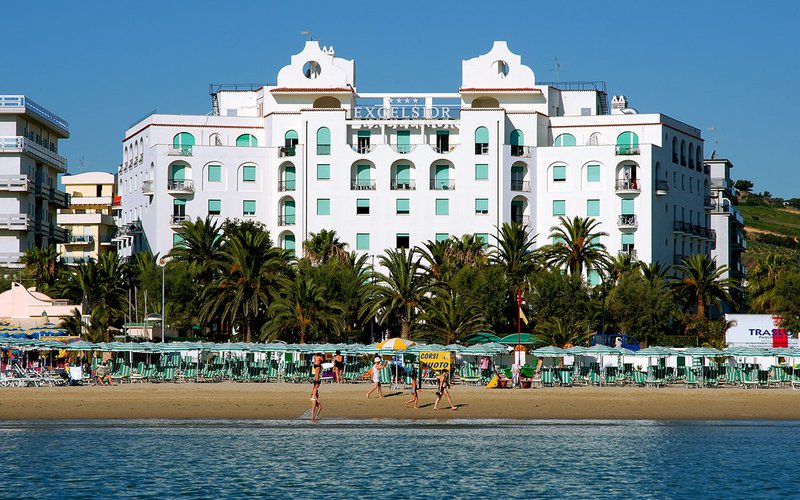
The historic four-star beachfront hotel in San Benedetto del Tronto had already been identified in 2026 as an asset potentially heading for sale. Now, according to local press reports, an application has reportedly been submitted in connection with the conversion of the property to residential use. The case raises a question that goes well beyond a single transaction: when does a hotel become worth more as apartments than as a hospitality business?
A hotel can be operational.
It can have guests.
It can offer beachfront rooms, swimming pools, a spa, restaurant facilities, a private beach club and a highly recognisable location.
And yet the real estate market may assign the same building a higher value if it ceases to operate as a hotel.
This is one of the most important structural issues facing Italian hospitality.
The Grand Hotel Excelsior in San Benedetto del Tronto provides a particularly interesting case study.
In February 2026, the Sorge family confirmed its intention to consider a sale of the property. According to Pambianco Hotellerie, a valuation in the region of €14 million had already been discussed in previous years, while in 2026 the ownership was reportedly assessing expressions of interest.
The same source had already highlighted uncertainty over whether the property would retain its hospitality use, including the possibility of a future residential conversion.
A further development emerged in October 2026.
According to local press reports, an application has reportedly been filed with the municipal planning authorities in connection with the conversion of the property into residential units.
A planning application is not the same as an approval.
It does not mean that the conversion has already been authorised, nor that hotel operations have definitively ceased.
Official and industry sources continue to list the Excelsior as an operating four-star hotel.
It is precisely this transitional phase that makes the case especially relevant for InvestimentiAlberghieri.it.
The question is not:
“Will the Excelsior become apartments?”
The correct question is:
“Why can a beachfront hotel property potentially create more value once it is removed from hospitality use?”
The Asset: A Four-Star Beachfront Hotel
The Grand Hotel Excelsior is located at 137 Viale Rinascimento, directly on the seafront in San Benedetto del Tronto.
The hotel's official website lists:
-
120 rooms;
-
4 suites;
-
16 family accommodation units;
-
private beach facilities;
-
swimming pools;
-
wellness centre;
-
restaurant;
-
panoramic terrace;
-
family-oriented services.
This is therefore not an abandoned hotel building.
It is an established hospitality product, located directly on the waterfront and supported by a service platform that requires capital, staff and operational complexity.
And this is precisely where the tension between:
business value and real estate value
begins.
A Hotel Has at Least Two Different Values
Every hotel incorporates two distinct economic components.
1. Real Estate Value
Driven by:
-
location;
-
floor area;
-
beachfront exposure;
-
building volume;
-
permitted uses;
-
residential demand;
-
subdivision potential;
-
value per square metre.
2. Hotel Operating Value
Driven by:
-
keys;
-
ADR;
-
occupancy;
-
RevPAR;
-
F&B;
-
GOP;
-
EBITDA;
-
CAPEX;
-
staffing;
-
distribution;
-
seasonality;
-
management capability.
The issue arises when these two values diverge.
If the net value achievable through residential conversion exceeds the value of the hotel capitalised on its operating cash flows, the owner faces a very powerful economic incentive.
Continue operating hospitality, or monetise the underlying real estate?
The Formula That May Determine the Future of the Asset
The comparison can be reduced to two basic equations.
Hotel Value
Stabilised EBITDA / Required Yield = Hotel Value
Residential Residual Value
Gross Development Value
− conversion CAPEX
− professional fees
− financing costs
− taxes
− marketing costs
− developer margin
= Residential Residual Value
If the second value materially exceeds the first, hospitality loses economic competitiveness.
Not necessarily because the hotel performs poorly.
But because the alternative use creates more value for the capital employed.
That is the core analysis InvestimentiAlberghieri.it should apply to an asset of this kind.
€14 Million? The Number Alone Tells Us Very Little
In February 2026, a previous valuation indication in the region of €14 million was referenced in connection with the Excelsior.
It is an interesting benchmark.
But it should not automatically be treated as the current value of the property.
To determine whether €14 million is:
-
high;
-
low;
-
sustainable;
-
consistent with hotel economics;
-
consistent with residential economics;
an investor would need access to information that is not publicly available.
At a minimum:
-
revenue;
-
GOP;
-
normalised EBITDA;
-
occupancy;
-
ADR;
-
deferred CAPEX;
-
labour costs;
-
total floor area;
-
actual planning potential;
-
developable residential value.
Without this information, the number remains only a reference point.
Seasonality Makes the Comparison More Demanding
The Grand Hotel Excelsior operates in a market with a strong seaside and leisure component.
For a seasonal hotel, the ability to generate profit is concentrated into a relatively limited number of months.
Cash flow must support:
-
payroll;
-
maintenance;
-
utilities;
-
distribution;
-
marketing;
-
insurance;
-
property costs;
-
CAPEX reserve;
-
potential rent;
-
debt service;
-
equity return.
This makes the comparison with residential particularly challenging.
An apartment monetises space.
A hotel must monetise space + time + service.
Residential Monetises Square Metres. Hospitality Monetises Nights.
The economic distinction is straightforward.
Residential
sqm × selling price per sqm
Hospitality
keys × 365 × occupancy × ADR
followed by:
revenue → GOP → EBITDA → value
Residential development monetises the physical space.
A hotel must monetise that same space repeatedly, every day, while carrying a far more complex operating structure.
This is why properties in prime locations can experience natural pressure toward alternative uses.
“The Hotel Is Full” Is Not Enough
Occupancy is not the same as profitability.
The correct sequence is:
Occupancy × ADR = RevPAR
then:
Room Revenue + F&B + Ancillary Revenue = Total Revenue
then:
Total Revenue − Operating Costs = GOP
then:
GOP − Fixed Charges = EBITDA
Only then can value begin to be assessed.
On Investhotel.it, this distinction is fundamental because a hotel's ability to defend its underlying real estate value ultimately depends on the cash flow it can generate.
The Excelsior's Real Competitor May Be the Apartment
Hotels are normally considered to compete with other hotels.
But from a real estate perspective, the competitor may belong to an entirely different asset class.
Residential.
If beachfront residential demand supports values materially above those that can be justified by hotel cash flows, the hotel is effectively competing with the residential market.
That is a particularly difficult form of competition because the two asset classes operate under completely different economic models.
San Benedetto Has Already Lost Other Hotels
The Excelsior is not an isolated case.
In previous years, other hotels in San Benedetto del Tronto were sold and converted into private residential units.
This makes the Excelsior significantly more important from an investment perspective.
Because the issue may not simply concern one owner's strategic decision.
It may reflect a broader structural dynamic:
beachfront hotels are increasingly being exposed to alternative real estate uses capable of generating higher residual value.
From the Destination's Perspective, the Equation Changes
For an individual property owner, residential conversion may be entirely rational.
For the tourism destination, the economics are different.
Every hotel that disappears reduces:
-
organised accommodation capacity;
-
employment;
-
demand for local suppliers;
-
F&B spending;
-
tourism-related economic activity;
-
group capacity;
-
potential conference business;
-
accommodation-related tax revenues.
Private value and destination value do not necessarily coincide.
This is where the issue becomes one of tourism policy.
Planning Restrictions Alone Are Not Enough
The comparison with Porto Ercole is particularly revealing.
In Porto Ercole, the Municipality is seeking to preserve hotel use by imposing it for fifty years.
In San Benedetto, the market appears to be moving in the opposite direction.
But regulation alone does not solve the underlying economic issue.
If a hotel cannot produce a competitive return, the owner may:
-
defer CAPEX;
-
reduce investment;
-
seek a buyer;
-
change operator;
-
pursue conversion.
To genuinely preserve hospitality stock, the hotel use must remain economically competitive.
Before Converting: Is There Still a Viable Hotel Investment Case?
Before concluding that residential conversion is inevitably the highest-value option, an advisor should compare at least four scenarios.
Scenario 1 — Existing Hotel
Retain the current operating model with selective CAPEX.
Scenario 2 — Repositioned Hotel
Refurbish and upgrade the product through:
-
higher ADR;
-
stronger RevPAR;
-
reduced seasonality;
-
greater F&B contribution;
-
improved distribution;
-
new customer segments.
Scenario 3 — Brand / Management
Introduce an operator or brand capable of improving pricing, distribution and market penetration.
Scenario 4 — Residential Conversion
Discontinue hotel operations, convert the property and monetise the real estate.
Only by comparing all four scenarios can the true highest and best use be determined.
How Much CAPEX Is Required to Defend the Hotel Use?
This may be the decisive variable.
If the hotel can materially increase ADR and EBITDA through relatively moderate CAPEX, retaining the hospitality use may still make economic sense.
If substantial investment is required merely to remain competitive, the gap against residential widens.
The correct comparison is therefore:
Existing Hotel Value
versus
Repositioned Hotel Value − CAPEX
versus
Residential Residual Value
These are three fundamentally different numbers.
Ownership and Management Do Not Have to Be the Same
Another common mistake is to equate an owner's desire to exit hotel operations with the inevitable loss of the hotel use.
The asset could theoretically be:
-
sold to a hotel investor;
-
leased to an operator;
-
placed under a management agreement;
-
affiliated with a brand;
-
integrated into a larger hotel portfolio.
This is the type of issue analysed by HotelManagementGroup.it.
A breakdown in the owner-operator model does not automatically mean that the hotel asset itself is no longer viable.
Sometimes it simply means the property needs a new ownership and management structure.
How Much Should a Hotel Investor Pay?
An investor seeking to retain the Excelsior as a hotel should calculate the Maximum Acquisition Price from prospective cash flow rather than from an asking price.
Conceptually:
Stabilised EBITDA
÷ Required Yield
= Stabilised Hotel Value
less:
-
CAPEX;
-
transaction costs;
-
financing carry;
-
working capital;
-
contingency;
-
target investor return;
equals:
Maximum Sustainable Acquisition Price
If that figure is lower than the residual value achievable through residential conversion, the hotel investor starts from a structural disadvantage.
This is a mathematical issue before it is a strategic one.
The Role of Finance
A hotel project can only support leverage to the extent that its cash flow can service the debt.
A lender will assess:
-
EBITDA;
-
DSCR;
-
debt yield;
-
LTV;
-
break-even occupancy;
-
seasonality;
-
CAPEX;
-
operator track record.
Residential development follows a different financing logic, based largely on development cost, sales velocity and exit pricing.
The comparison between the two uses must therefore also account for the cost and availability of capital.
Avoiding an Emotional Reading of the Case
When a historic hotel faces the possibility of residential conversion, the natural reaction is often negative.
But an advisor must separate:
emotion, tourism policy and capital allocation.
If an asset generates more value as residential than as a hotel, it is not enough to ask the owner to give up the economic difference.
The correct question is why that gap exists.
And whether it can be reduced through:
-
better management;
-
repositioning;
-
branding;
-
CAPEX;
-
season extension;
-
operational efficiency;
-
a different capital structure.
That is where advisory work begins.
A National Issue, Not Merely a Marche Case
The Excelsior belongs to a much broader phenomenon.
In many Italian destinations — especially coastal, urban and prime locations — hotels increasingly compete against:
-
residential;
-
branded residences;
-
serviced apartments;
-
student housing;
-
senior living;
-
mixed-use.
When Alternative Use Value grows faster than hotel EBITDA, the pressure toward conversion increases.
On Robertonecci.it, this should be viewed as one of the structural transformations affecting Italy's hospitality sector.
It is not enough to count how many new rooms enter the market.
We also need to measure how many existing rooms are at risk of disappearing.
A New Metric: Hotel Rooms at Risk
The market constantly monitors:
-
pipeline;
-
openings;
-
ADR;
-
RevPAR;
-
transactions;
-
new brands.
But another metric deserves attention:
Hotel Rooms at Risk
Rooms located in properties where:
Alternative Use Value > Hotel Investment Value
These are the assets most exposed to conversion.
And they are often located in the most valuable locations.
Conclusion: The Excelsior Is a Test of the Economic Value of Hospitality
The Grand Hotel Excelsior case is not merely about the future of one four-star hotel.
It raises a far more important question:
How much must a hotel earn to prevent its underlying real estate from becoming more valuable without the hotel?
The answer cannot be ideological.
It must be economic.
The correct comparison is:
Existing Hotel Value
vs
Repositioned Hotel Value
vs
Residential Residual Value
If residential clearly wins, the pressure to convert is economically rational.
If repositioning allows the hotel to recover competitiveness, hospitality may still be able to defend its value.
But there is a second question for the destination itself:
How much hotel stock can a tourism market lose before rising real estate values begin to destroy the tourism value of the destination itself?
That may ultimately be the most important question raised by the Excelsior case.
InvestimentiAlberghieri.it | Advisory
InvestimentiAlberghieri.it analyses hotels, hospitality assets and conversion opportunities for investors, owners, banks, family offices and operators.
Our work may include:
-
hotel investment analysis;
-
highest and best use;
-
hotel vs residential analysis;
-
business planning;
-
CAPEX analysis;
-
repositioning;
-
lease vs management assessment;
-
operator selection;
-
financial modelling;
-
debt sizing;
-
stabilised EBITDA;
-
residual value analysis;
-
Maximum Acquisition Price.
A property should not remain a hotel simply on principle.
Hospitality must demonstrate that it can generate a competitive return on capital.
📩 info@investimentialberghieri.it
Ecosystem:
InvestimentiAlberghieri.it — Hospitality Real Estate & Investment Advisory
Investhotel.it — Hotel Finance, Debt & Investment Strategy
HotelManagementGroup.it — Hotel Operations, Management & Performance
Robertonecci.it — Hospitality Industry, Strategy & Market Analysis
Editorial and Legal Disclaimer
Information concerning the potential sale of the asset and possible future uses of the property is based on publicly available journalistic sources.
Information regarding the hotel's characteristics and services is based on the property's official website and relevant industry sources.
Information relating to the October 2026 planning development is attributed to local press reports.
A request for a change of use does not in itself constitute planning approval, a building permit or confirmation that hotel operations will cease.
Any discussion of residential conversion, repositioning, CAPEX, management structures, residual value or investment scenarios represents professional analytical scenarios only and should not be interpreted as evidence of decisions already taken by the owner, the Municipality or any prospective buyer.