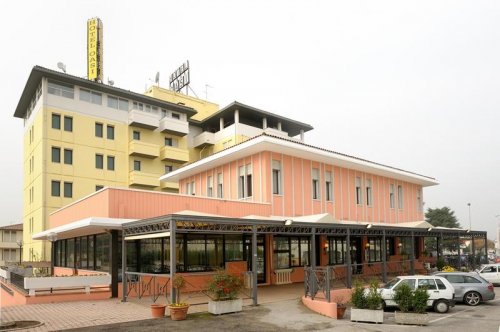
69 rooms, a restaurant-pizzeria, two apartments, approximately 3,000 sqm of parking and a property currently described as unused. The base price has fallen from €830,000 to €468,000.
The Hotel Oasi in Conselve, in the province of Padua, is interesting not because the price is low.
It is interesting because it forces an investor to answer a much more important question:
which use can generate the highest return on the total capital invested?
That is the real issue.
In distressed hospitality, the acquisition price is only one part of the transaction.
The real investment is:
**Acquisition Cost
-
Transaction Costs
-
CAPEX
-
FF&E
-
Working Capital
-
Pre-Opening
-
Ramp-Up**
Only once this figure has been determined can the investor assess whether the asset is genuinely attractive.
The asset perimeter
Publicly available documentation relating to proceeding no. 257/2024 before the Court of Padua describes the full ownership of a complex known as Hotel Oasi, located at Via Gioacchino Rossini 2 in Conselve.
The complex includes:
-
a three-star hotel;
-
69 rooms;
-
a restaurant-pizzeria with independent access;
-
two multifunction rooms;
-
two apartments;
-
garages;
-
technical rooms;
-
approximately 3,000 sqm of parking.
The building stands on a site of approximately 4,330 sqm, extends over several levels and is described as having originally been constructed in the late 1960s and subsequently expanded.
The published documentation describes the property as currently unused.
This means the investor is not analysing a stabilised hotel.
The investor is analysing an asset that needs to be:
reactivated, repositioned or transformed.
The base price has fallen by 44%
The history of the procedure shows a progressive reduction in the base price:
5 March 2026 — €830,000
16 June 2026 — €623,000
15 December 2026 — €468,000
with a stated minimum bid of:
€351,000
Compared with the first base price, the reduction is approximately 44%.
Dividing the minimum bid by 69 rooms produces an apparent value of just over:
€5,000 per room
But taken in isolation, that number is almost meaningless.
It is not a genuine hotel price per key.
It is simply the theoretical entry price into the real estate asset.
The real price per key must include CAPEX
The key metric is not:
€351,000 / 69 rooms.
It is:
Total Investment Cost / 69 rooms.
Because the acquisition price must be supplemented by:
-
refurbishment;
-
MEP systems;
-
guestrooms;
-
bathrooms;
-
fire and life safety works;
-
energy upgrades;
-
FF&E;
-
technology;
-
kitchens;
-
F&B areas;
-
reopening costs;
-
marketing;
-
staffing;
-
working capital;
-
ramp-up.
If CAPEX were to exceed the acquisition price several times over, the low entry price would become far less relevant.
This is precisely the principle underlying the analysis performed by InvestimentiAlberghieri.it:
a hotel is not attractive because it is cheap. It is attractive when the total capital invested can generate a return commensurate with the risk assumed.
The central question: should it still be a hotel?
This is probably the most important issue in the entire case.
The published information also refers to the possibility of an alternative use.
Any such scenario would naturally require:
-
urban planning due diligence;
-
building compliance review;
-
cadastral verification;
-
administrative analysis;
-
technical feasibility assessment.
But the mere existence of this possibility changes the investment framework.
The investor should not ask only:
what is it worth as a hotel?
At least three scenarios should be compared.
Scenario A — Hotel reopening
Refurbishment and relaunch of the 69-room property.
Scenario B — Hospitality repositioning
Conversion into serviced apartments, aparthotel, extended stay or another compatible hospitality format.
Scenario C — Alternative value creation
A different use, where technically and legally permitted.
This is a classic:
Highest and Best Use analysis.
And it is probably the real economic key to the transaction.
The market study comes before the business plan
A low real estate price does not prove that Conselve can economically support 69 hotel rooms.
The first step is to establish:
-
corporate demand;
-
leisure demand;
-
local demand generators;
-
the influence of the Padua market;
-
sustainable occupancy;
-
sustainable ADR;
-
competitive supply;
-
group demand;
-
events demand;
-
the economic role of the restaurant;
-
the potential of the meeting spaces;
-
the strategic value of parking.
This is where HotelIntelligence.it becomes critical.
A property can be acquired cheaply.
But hotel value only exists if demand can support:
occupancy + ADR + profitability.
The business plan must start with RevPAR
For a hotel reopening, at least three scenarios would be required:
Downside
Base Case
Upside
For each scenario, the analysis should determine:
-
Occupancy;
-
ADR;
-
RevPAR;
-
Room Revenue;
-
F&B Revenue;
-
Other Revenue;
-
Payroll;
-
Departmental Costs;
-
Undistributed Expenses;
-
GOP;
-
EBITDA;
-
Maintenance CAPEX;
-
Free Cash Flow.
The model can be summarised as:
Occupancy × ADR × Available Rooms = Room Revenue
then:
**Room Revenue
-
F&B
-
Other Revenue
− Departmental Expenses
− Undistributed Operating Expenses
= GOP**
and finally:
GOP
− Fixed Charges
− Maintenance CAPEX
= Operating Cash Flow
This is the level at which HotelControl.it can distinguish a superficially inexpensive property from an economically viable investment.
69 rooms: large enough to require a real operating platform
Hotel Oasi is not a small property.
With 69 rooms, food & beverage and ancillary spaces, it requires a genuine operating organisation.
At a minimum, the structure needs to account for:
-
front office;
-
housekeeping;
-
maintenance;
-
administration;
-
sales;
-
breakfast;
-
potentially full restaurant operations;
-
management.
Scale can create efficiency.
But only if occupancy is sufficient.
Otherwise, fixed costs can quickly become burdensome.
The right question is therefore not:
how much revenue can it generate?
It is:
what sustainable GOP can it generate?
The real risk is underestimating CAPEX
The original structure dates back to the late 1960s.
This does not automatically mean that the property is in poor condition.
It does mean, however, that technical due diligence becomes critical.
At a minimum, the following should be reviewed.
Structure and building envelope
Condition of the building fabric, façades, roofs and windows.
MEP systems
Electrical, plumbing, HVAC, lifts and domestic hot water systems.
Fire & Life Safety
Required upgrades for the intended future use.
Energy
Energy efficiency and prospective operating costs.
Guestrooms
Bathrooms, layouts, acoustic insulation and lighting.
F&B
Kitchens, extraction systems, dining areas and back-of-house spaces.
Technology
PMS, Wi-Fi, access control, CCTV and BMS.
The principal risk is not overpaying for the asset.
It is:
buying cheaply and discovering afterwards that CAPEX makes the investment uneconomic.
Maintenance CAPEX and Growth CAPEX
Another essential distinction.
Maintenance / Compliance CAPEX
How much capital is required simply to make the property usable and compliant again?
Growth CAPEX
How much additional capital is required to make the asset genuinely competitive and increase its value?
Spending the minimum needed to reopen does not mean creating a product capable of generating attractive returns.
The business plan should therefore compare:
Minimum Reopening CAPEX
with
Competitive Repositioning CAPEX.
The second figure is what determines the real upside potential of the asset.
Parking is a strategic component of value
Approximately 3,000 sqm of parking is a meaningful asset component.
It may improve competitiveness for:
-
corporate guests;
-
groups;
-
meetings;
-
banqueting;
-
restaurant customers;
-
drive-to demand;
-
potential alternative uses.
In a case such as Hotel Oasi, value is not concentrated solely in the guestrooms.
It lies in the combination of:
rooms + F&B + parking + apartments + multifunctional spaces.
Restaurant and function rooms: profit centre or liability?
The restaurant with independent access and the multifunction rooms need to be assessed separately.
Potential options include:
-
direct operation;
-
leasing to a third party;
-
banqueting;
-
integration with hotel operations;
-
complete repositioning.
Each solution produces a different mix of:
revenue + margin + risk + capital requirement.
The objective is not to maximise turnover.
It is:
to maximise return on invested capital.
Reopening requires a new commercial strategy
A potential relaunch cannot be limited to physical refurbishment.
The property would also need to be repositioned commercially.
HotelMarketingLab.it should work on:
-
positioning;
-
brand;
-
website;
-
direct booking;
-
OTA strategy;
-
Google Hotel Ads;
-
CRM;
-
corporate accounts;
-
local SEO;
-
reputation;
-
revenue management.
Reopening without rebuilding demand means deploying capital without solving the underlying industrial problem.
Real estate distress does not automatically mean UTP or NPL
The public procedure documents a real estate enforcement process.
This does not automatically allow the underlying credit to be classified as:
UTP
or
NPL.
These are different concepts.
The enforcement process is clearly a sign of distress.
But the credit classification would require specific information about the borrower-lender relationship.
Investhotel.it focuses precisely on the distinction between:
asset value
cash flow generation
debt sustainability
capital structure.
A documentary issue that needs clarification
The published documentation contains one point that should be verified.
The complex is described as:
“unused”
while the procedure also formally indicates the property as:
“occupied”.
These two statements may be compatible.
But they require clarification regarding:
-
who is in occupation;
-
under what legal title;
-
which parts of the property are affected;
-
whether contracts exist;
-
when full possession could realistically be obtained.
This may appear secondary, but it can directly affect the timing and cost of the investment.
Price is not Value
The base price has fallen from:
€830,000
to
€468,000
But the economic value of the transaction has not necessarily improved to the same extent.
Meanwhile:
-
the building continues to age;
-
CAPEX may increase;
-
physical deterioration may continue;
-
reopening delays remain costly;
-
committed capital has a cost.
Distressed real estate therefore follows a fundamental rule:
Price ≠ Value
and, above all:
Low Price ≠ Good Investment.
The Investimenti Alberghieri framework
A case such as Hotel Oasi should be analysed through eight workstreams.
1. Technical Due Diligence
Physical condition and CAPEX.
2. Urban & Planning Review
Permitted uses and feasibility of alternatives.
3. Market Study
Hotel demand and alternative-use scenarios.
4. Hotel Business Plan
Occupancy, ADR, RevPAR, GOP and cash flow.
5. Highest and Best Use
Comparison between hospitality and alternative uses.
6. Real Estate Valuation
Current value and post-investment value.
7. Total Investment Cost
Acquisition + CAPEX + Working Capital + Startup.
8. Exit Analysis
Stabilised value, IRR and equity multiple.
Only once these analyses are complete can an investor determine whether €351,000 is genuinely attractive or simply the first cost in a much larger investment programme.
Investment Case — Executive View
Strengths
-
69 rooms;
-
approximately 4,330 sqm site;
-
approximately 3,000 sqm of parking;
-
standalone restaurant;
-
multifunction rooms;
-
two apartments;
-
44% reduction in the base price;
-
optionality to assess alternative uses.
Risks
-
currently unused property;
-
original building dates from the 1960s;
-
unquantified CAPEX;
-
hotel demand still to be demonstrated;
-
potential technical complexity;
-
reopening timeframe;
-
occupation status still to be clarified.
Missing Data
A proper assessment would require at least:
-
detailed CAPEX;
-
MEP condition;
-
planning compliance;
-
potential ADR;
-
stabilised occupancy;
-
RevPAR;
-
GOP;
-
payroll;
-
utility costs;
-
working capital;
-
independent real estate valuation;
-
alternative-use value.
Decision Trigger
The transaction becomes compelling only if:
Total Investment Cost
is consistent with:
Stabilised EBITDA / GOP + Exit Value
and produces a risk-adjusted return.
That is the real decision point.
Not the €351,000 entry price.
Four numbers that should not be confused
€830,000
Initial base price.
€468,000
Current base price.
€351,000
Minimum bid.
69
Number of rooms.
But the most important number is still missing:
Total Investment Cost.
Until that figure is known, calling the asset an “opportunity” would be premature.
Our assessment
Hotel Oasi is interesting because it represents a classic distressed asset with strategic optionality.
There may be an opportunity in reopening it as a hotel.
There may be an opportunity in repositioning it.
There may be greater value in an alternative use.
These are scenarios.
Not conclusions.
The answer can only emerge from the intersection of:
market data + CAPEX + operations + urban planning + finance.
At RobertoNecci.it, we have long analysed the relationship between real estate value and the ability of an asset to generate income.
HotelManagementGroup.it provides the operating perspective.
HotelIntelligence.it measures market depth and potential performance.
HotelControl.it tests profitability and economic sustainability.
HotelMarketingLab.it builds the demand-generation model.
Investhotel.it links profitability, capital and debt.
InvestimentiAlberghieri.it brings these elements together within the overall investment case.
Conclusions
The Hotel Oasi in Conselve case perfectly illustrates why a distressed asset cannot be judged on price alone.
A minimum bid of €351,000 for 69 rooms may appear exceptionally low.
But that number, on its own, does not determine value.
The two real questions are:
how much capital needs to be invested today to generate what cash flow tomorrow?
and:
is hotel use really the highest and best use of the property?
These are the questions that ultimately determine the quality of the investment.
A professional investor is not simply acquiring guestrooms, real estate or square metres.
The investor is acquiring:
future cash flow.
Where that cash flow does not yet exist, the real skill lies in determining whether it can be built — and at what cost.
Investimenti Alberghieri | Distressed Hospitality & Special Situations
InvestimentiAlberghieri.it analyses hotel assets and hospitality real estate through an integrated approach combining:
real estate + market intelligence + operations + CAPEX + financial modelling + value creation.
We do not operate as intermediaries.
Our work starts with the analysis of the underlying case in order to understand:
-
asset value;
-
key risks;
-
capital requirements;
-
economic sustainability;
-
strategic alternatives;
-
value creation potential.
For hotel asset analysis, pre-distress situations, UTP cases, repositioning opportunities and hospitality special situations:
info@investimentialberghieri.it
Methodological Note and Disclaimer
Article updated as of 11 October 2026.
This analysis is based exclusively on publicly available information relating to proceeding no. 257/2024 before the Court of Padua.
Information concerning the configuration of the property, number of rooms, ancillary spaces, unused status and published prices derives from publicly available documentation relating to the procedure.
The simultaneous description of the property as unused and formally occupied requires further verification of the complete documentation and of the property's actual physical and legal status.
Any alternative-use scenario would require specific urban planning, building, technical and administrative due diligence.
This article does not state that the underlying credit exposure is classified as UTP or NPL and does not express any view regarding the liability of any party involved.
The scenarios described are analytical only and do not constitute a valuation, an offer, an investment solicitation or a definitive assessment of the economic merits of the transaction.
Any investment decision would require access to complete documentation and specific legal, technical, planning, tax, financial and commercial due diligence.