From a reported €14 million property acquisition to the development of a luxury hotel: an investment analysis covering development costs, revenue potential, operating profitability, capital efficiency and financial sustainability.
Investimenti Alberghieri | 20 November 2026
Palazzo Arrigoni: A New Five-Star Hotel Takes Shape in Trieste
Italy's hospitality real estate market continues to attract investment in the conversion of historic buildings, particularly projects designed to create upscale and luxury hotel properties.
One of the most noteworthy developments currently underway is Palazzo Arrigoni in Trieste, a historic building scheduled to become a five-star hotel featuring approximately 150 guest rooms, with an anticipated opening in early 2028.
According to the Italian newspaper Il Piccolo, which reported on the project on 20 November 2026, entrepreneur Leonardo Groppelli outlined the development plans being pursued through Milan-based Hotel Mozart Srl.
The property was reportedly acquired for approximately €14 million, although an earlier report published in July 2026 placed the transaction value at €14.98 million.
Construction work is already underway, positioning the development within Trieste's broader transformation into an increasingly sophisticated hospitality destination.
For investors, however, the central question extends well beyond the architectural restoration of a historic property.
The fundamental issue is whether the completed hotel will generate sufficient revenue, operating profit and sustainable cash flow to justify the total capital committed to the project.
That is the essential distinction between an attractive real estate redevelopment and a financially viable hotel investment.
It is also the starting point for any rigorous hospitality feasibility assessment.
Palazzo Arrigoni: Location, Scale and Hotel Development Potential
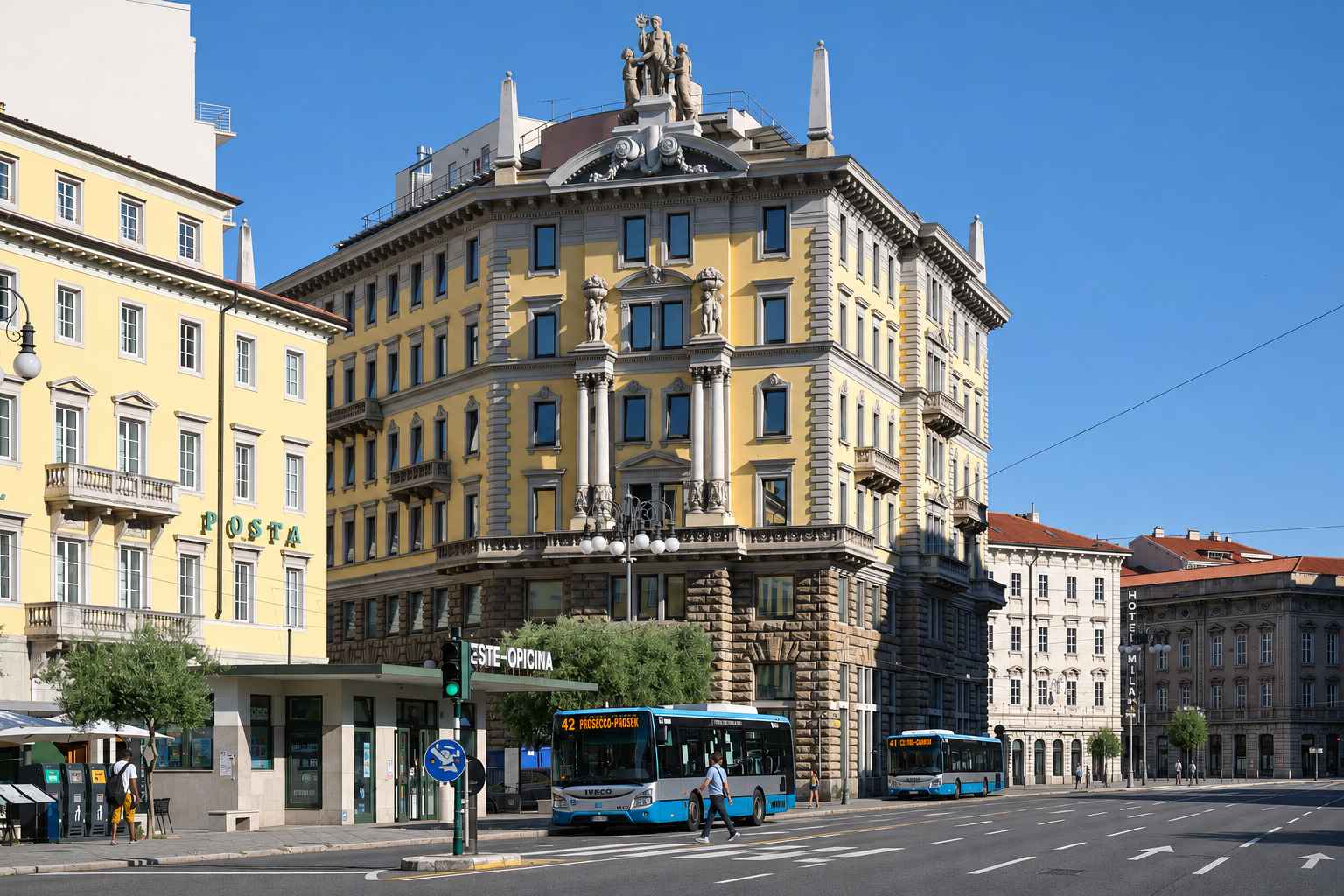
The property occupies a strategic location in the area surrounding Piazza Oberdan, Piazza Dalmazia and Via Filzi, close to Trieste's main railway station and important urban transport connections.
Reports published in July 2026 indicated that the redevelopment would involve approximately 9,000 square metres of space.
Dividing this figure by the proposed 150 guest rooms produces an initial development density indicator:
9,000 sq m / 150 rooms = 60 sq m of gross floor area per room.
This figure does not represent the average size of an individual guest room.
Rather, it is a preliminary ratio between the overall floor area and the proposed accommodation capacity, encompassing guest circulation areas, public spaces, back-of-house facilities, technical rooms and other supporting functions.
From a preliminary planning perspective, this ratio may be compatible with a full-service five-star hotel.
However, a professional feasibility assessment would require detailed architectural drawings, confirmation of usable floor areas and a thorough understanding of the proposed functional layout.
Converting a historic building into a luxury hotel also introduces a range of project-specific challenges:
-
Structural refurbishment and mechanical, electrical and plumbing upgrades.
-
Compliance with heritage preservation requirements.
-
Efficient separation of guest, staff and service circulation.
-
Accessibility, fire safety and operational compliance.
-
Integration of restaurants, meeting facilities and ancillary services.
-
Energy efficiency and long-term maintenance expenditure.
-
Deliveries, logistics, access arrangements and parking solutions.
The commercial success of the development will depend on achieving the right balance between architectural quality, operational functionality and long-term cost efficiency.
A prestigious historic building is not, by definition, a profitable hotel investment.
Is Trieste Becoming an Increasingly Attractive Hotel Investment Market?
Recent tourism figures point to sustained growth in demand.
According to statistics published by the Venezia Giulia Chamber of Commerce, the Province of Trieste recorded the following results in 2025:
| Indicator | 2025 Performance |
|---|---|
| Total tourist overnight stays | 2,082,909 |
| Growth versus 2024 | +11.3% |
| Overnight stays in hotels | 1,061,746 |
| Growth in hotel overnight stays | +7.5% |
| International tourist overnight stays | 1,215,478 |
| Average length of stay | 2.63 nights |
The expansion of international demand is particularly relevant for investors targeting the upscale and luxury segments.
In September 2026, Federalberghi Trieste also reported an 11% increase in international tourist overnight stays during the first half of the year compared with the corresponding period in 2025.
Several structural factors support the destination's appeal.
Cultural tourism. Trieste's architectural heritage, distinctive Central European identity and geographical position contribute to its international attractiveness.
Corporate travel. The city's economic activity and connections with Central European markets support business-related accommodation demand.
Meetings and events. The development of conference and event facilities offers opportunities to reduce seasonality and diversify the demand mix.
International tourism. Trieste's proximity to Central and Eastern European markets provides access to a geographically diversified visitor base.
Nevertheless, growth in tourist arrivals and overnight stays does not automatically translate into financially sustainable luxury hotel developments.
Headline tourism statistics do not establish the achievable average daily rate, revenue per available room or operating profitability of a new five-star property.
For this reason, the investment assessments published by Investimenti Alberghieri treat tourism demand as one component of a broader financial and operational analysis—not as sufficient evidence of investment viability.
Hotel Supply Is Expanding: Up to 650 Additional Rooms Expected by 2029
The most important market consideration is the expected increase in accommodation supply.
In September 2026, Federalberghi Trieste indicated that more than 500 additional quality hotel rooms were expected to enter the market.
A subsequent report published by Confcommercio Trieste on 4 November 2026 suggested that the city's hotel inventory could expand by as many as 650 rooms by 2029.
Another significant project involves the redevelopment of the former railway administration building in Piazza Vittorio Veneto, with plans reportedly including a hotel of approximately 174 rooms alongside other residential and accommodation uses.
These developments could strengthen Trieste's overall positioning as an international hospitality destination.
However, additional hotel capacity must ultimately be supported by corresponding growth in demand.
If supply expands faster than the market can absorb it, competition may put downward pressure on room rates and operating performance.
For Palazzo Arrigoni, the key issue is therefore not simply how many visitors Trieste can attract.
It is whether the destination can consistently attract customer segments willing to pay the rates required to support a luxury hotel's cost structure and capital investment.
A comprehensive competitive assessment should examine established upscale properties, including the Grand Hotel Duchi d'Aosta and Savoia Excelsior Palace, alongside new projects under development.
Such an assessment should consider product quality, market segmentation, distribution strategy, service standards and actual operating performance.
Published online room rates alone should not be treated as reliable evidence of annual achieved ADR.
What Is the True Cost of Converting Palazzo Arrigoni into a Five-Star Hotel?
The reported acquisition price is only one component of the project's overall capital requirement.
Using an illustrative purchase price of €14 million, the initial property acquisition cost would amount to approximately:
€93,300 per planned guest room.
This figure should not be confused with the total development cost per completed room.
The conversion will also require substantial investment in construction, building services, interior design, furniture, fixtures and equipment (FF&E), professional fees, technical works, regulatory compliance and pre-opening activities.
Depending on the development structure, financing costs, transaction expenses and additional working capital requirements may also need to be considered.
CAPEX Analysis: Three Illustrative Development Scenarios
In the absence of an officially disclosed development budget, three hypothetical scenarios can be constructed using the reported 9,000-square-metre area and different assumed conversion costs.
| Indicator | Lower-Cost Scenario | Base Scenario | Higher-Cost Scenario |
|---|---|---|---|
| Property acquisition | €14m | €14m | €14m |
| Conversion CAPEX | €18m | €27m | €36m |
| Illustrative total investment | €32m | €41m | €50m |
| Total investment per room | €213,000 | €273,000 | €333,000 |
The conversion expenditure assumptions correspond to €2,000, €3,000 and €4,000 per square metre respectively.
These figures are illustrative modelling assumptions, not contractor quotations or independently verified construction cost estimates.
For the purposes of the simulation, conversion CAPEX is assumed to include construction works, building services, fit-out, FF&E, professional fees and an allowance for contingencies.
Potential financing costs, tax effects, transaction costs and any additional funding requirements not covered by those assumptions are excluded.
The scenarios therefore do not represent official estimates for Palazzo Arrigoni.
Nevertheless, they demonstrate an important investment principle.
The acquisition price of a hotel development property may account for less than half the capital ultimately required to deliver a fully operational asset.
Consequently, investment returns must be measured against the total project cost, not simply against the original real estate purchase price.
This distinction is essential when assessing historic property conversions.
How Much Revenue Could a 150-Room Five-Star Hotel Generate?
The first step is to establish the property's theoretical accommodation capacity.
Assuming 150 rooms are available throughout the year:
150 rooms × 365 days = 54,750 available room nights annually.
Rooms revenue will depend primarily on two variables.
Occupancy: the percentage of available rooms sold.
ADR — Average Daily Rate: the average revenue generated per room sold.
A third indicator, RevPAR — Revenue per Available Room, combines occupancy and ADR to measure room revenue performance against total available capacity.
Additional income may be generated through food and beverage operations, meetings, events and ancillary guest services.
Three Illustrative Stabilised Operating Scenarios
| Indicator | Conservative | Base Case | Upside |
|---|---|---|---|
| Rooms | 150 | 150 | 150 |
| Occupancy | 60% | 70% | 75% |
| ADR | €180 | €220 | €260 |
| RevPAR | €108 | €154 | €195 |
| Rooms revenue | €5.91m | €8.43m | €10.68m |
| Total revenue | €7.10m | €10.12m | €12.81m |
| GOP margin | 25% | 30% | 35% |
| Illustrative GOP | €1.77m | €3.04m | €4.48m |
Source: Investimenti Alberghieri illustrative financial modelling. Ancillary revenue is assumed at 20% of rooms revenue. GOP margins are hypothetical scenario assumptions rather than outputs from a detailed departmental operating budget. All scenarios represent potential stabilised performance, not first-year trading forecasts.
The difference between the conservative and upside scenarios is substantial.
Total annual revenue increases from approximately €7.1 million to €12.8 million, while gross operating profit rises from approximately €1.77 million to €4.48 million.
This demonstrates the considerable sensitivity of hotel profitability to achieved room rates, occupancy levels and operating efficiency.
However, GOP should not be interpreted as the amount of cash automatically available to the investor.
Depending on the ownership and operating structure, further deductions may be required for management fees, property-related expenses, maintenance reserves, replacement expenditure and other obligations.
The distinction between hotel operating performance and returns available to capital providers is fundamental.
The Central Investment Question: What Return Can the Capital Generate?
When assessing a hospitality development, one question ultimately determines the financial attractiveness of the project:
How does the total capital committed compare with the sustainable economic returns that the completed hotel can generate?
Answering this question requires looking beyond headline GOP.
For illustrative purposes, assume that 65% of the base-case GOP remains after additional property-level costs and reserves.
This percentage is not a verified market benchmark or a specific estimate for Palazzo Arrigoni. It is a modelling assumption used solely to demonstrate sensitivity to capital expenditure.
Under this assumption:
Illustrative GOP: €3.04 million.
Illustrative normalised annual cash flow: approximately €1.97 million.
This simplified figure is calculated before debt service and taxation and should not be interpreted as free cash flow to equity.
Illustrative Yield on Total Development Cost
| Total Investment | Illustrative Annual Cash Flow | Indicative Yield on Cost |
|---|---|---|
| €32m | €1.97m | 6.17% |
| €41m | €1.97m | 4.81% |
| €50m | €1.97m | 3.95% |
The implications are significant.
With operating performance held constant, higher development costs progressively reduce the yield on invested capital.
At a total investment of €32 million, the illustrative yield is slightly above 6%.
At €50 million, it falls below 4%.
These figures are not internal rates of return, equity returns or market valuations. They exclude the timing of development expenditure, the initial operating ramp-up, financial leverage and any potential exit proceeds.
They do, however, highlight a critical risk.
A hotel can deliver satisfactory operating results while still failing to produce an adequate return on the capital required to develop it.
Identifying this potential mismatch before substantial capital is committed is one of the primary objectives of a professional hotel feasibility study.
Break-Even Analysis: How Many Rooms Must Palazzo Arrigoni Sell?
Determining the operating break-even point is an essential component of hotel investment analysis.
Break-even is not the same as achieving the investor's required return.
It represents the level of business activity necessary to cover a defined set of operating costs.
Consider a simplified model based on the following assumptions:
-
Average daily rate: €220.
-
Ancillary revenue: 20% of rooms revenue.
-
Variable operating costs: 30% of total revenue.
-
Annual fixed operating costs: €4.05 million.
Under these assumptions, the hotel would reach an operating break-even point, measured at GOP level, at approximately:
40% annual occupancy.
In this illustrative model, occupancy of around 40% would generate sufficient revenue to cover the operating costs included in the calculation, before producing a meaningful gross operating profit.
This does not mean that investors would have recovered their capital or achieved an acceptable investment return.
Once property-level expenses, financing obligations, taxation and capital replacement requirements are incorporated, the financial break-even threshold could be materially higher.
A comprehensive assessment would also need to reflect seasonality, labour productivity, staffing requirements, departmental profitability and the fixed-cost structure of a luxury full-service property.
What Would the Hotel Need to Earn to Support a €41 Million Investment?
The base development scenario assumes a total investment of €41 million.
For sensitivity analysis, consider an illustrative target of a 6% annual normalised cash yield on development cost.
The corresponding annual cash flow requirement would be:
€41 million × 6% = €2.46 million.
Using the previous assumption that 65% of GOP converts into normalised cash flow, the hotel would need to generate approximately:
€3.78 million in annual GOP.
This is approximately €750,000 above the €3.04 million GOP projected in the base operating scenario.
Applying the same fixed- and variable-cost structure used in the break-even analysis, achieving that level of GOP would require approximately either:
-
70% occupancy at an ADR of €243, or
-
77.4% occupancy at an ADR of €220.
These results are theoretical and highly sensitive to assumptions regarding ancillary revenue, operating efficiency and fixed costs.
They do not demonstrate that Trieste's market can necessarily support either combination.
Instead, they illustrate how real estate investment decisions must be directly connected to achievable hotel operating performance.
If the market cannot sustain the occupancy, ADR or profitability required to justify the investment, the appropriate response may involve reducing development expenditure, repositioning the product, revising the financing structure or reconsidering the investment altogether.
This is where financial modelling becomes a decision-making instrument rather than simply a forecasting exercise.
The Often-Overlooked Variable: Operational Efficiency
The financial sustainability of a hospitality investment depends on more than property values and tourism demand.
It also depends on management quality.
A full-service luxury hotel typically involves greater operational complexity than a limited-service accommodation property.
Restaurants, personalised guest services, maintenance requirements, commercial operations, service standards and qualified personnel can materially affect profitability.
For this reason, GOP analysis must be supported by a detailed examination of the hotel's operating cost structure.
Occupancy alone is not enough.
Investors and owners should examine labour productivity, payroll as a percentage of revenue, distribution costs, departmental contribution margins, procurement efficiency and recurring capital expenditure.
Revenue measures a hotel's commercial scale. GOP provides an indication of its operating earning capacity. Sustainable cash flow ultimately determines its ability to remunerate invested capital.
Understanding the difference between these measures is central to professional hotel advisory.
International Brand or Independent Management?
Another important consideration is the operating model that the future hotel will adopt.
A five-star classification does not necessarily imply affiliation with an international hotel chain.
Potential structures include owner-operated management, independent third-party management, hotel management agreements, franchise arrangements and leases to specialist operators.
Each model involves a different allocation of responsibilities, risks and economic returns.
International hotel brands can offer benefits through brand recognition, distribution networks, loyalty programmes and established operating systems.
These potential advantages must nevertheless be assessed against franchise costs, management fees, contractual obligations, required capital improvements and operating restrictions.
Independent management can provide greater autonomy and flexibility, but requires strong organisational, commercial and financial capabilities.
As Roberto Necci explains in his analysis of tailored hotel advisory and achieving the efficiency of major hotel chains without sacrificing a property's identity, the objective should not be to adopt a particular operating model automatically.
The objective is to identify the organisational and management structure best suited to protecting and enhancing the owner's business and investment.
This approach involves introducing sophisticated management systems and professional operating controls without necessarily compromising a hotel's individuality or the owner's strategic independence.
For a historic property with a distinctive architectural identity, achieving this balance can be particularly important.
What Could Palazzo Arrigoni Be Worth Once Stabilised?
The economic value of an operating hotel cannot be established simply by adding its acquisition price to its refurbishment expenditure.
The capital invested in an asset and the value ultimately recognised by the market are two different measures.
A professional hotel valuation should examine several factors.
Normalised earning capacity. The sustainable operating results generated by the property after adjusting for exceptional or non-recurring items.
Future cash flows. The economic resources available after expected expenditure, property obligations and reinvestment requirements.
Investment risk. Market conditions, positioning, operating agreements, competitive exposure, liquidity and financing.
Market-required returns. Valuation parameters supported by genuinely comparable hotel transactions and investment evidence.
Terminal value. The estimated value of the asset at the end of the forecast period, taking account of future capital requirements and market assumptions.
A discounted cash flow (DCF) model is one of the techniques that may be applied to assess these factors.
It can be supported by comparable transaction analysis, relevant earnings multiples and an independent assessment of the property's real estate characteristics.
In the case of Palazzo Arrigoni, the publicly available information examined here is insufficient to produce a reliable estimate of the completed hotel's market value.
Presenting a valuation target based solely on an assumed GOP multiple would therefore be methodologically unsound.
The meaningful test is whether the hotel's prospective economic value can justify the capital required to create it.
Five Key Investment Risks
The analysis identifies five areas that should be investigated through appropriate due diligence before any final investment decision.
1. Development risk
Construction cost overruns, unforeseen structural issues, regulatory requirements and delays to completion may increase funding needs and weaken financial returns.
2. Commercial risk
The simultaneous arrival of additional hotel capacity could create competitive pressure on achievable room rates, particularly during the market's absorption of new supply.
3. Operating risk
A luxury property with substantial service requirements must maintain guest satisfaction and quality standards while preserving productivity and operating margins.
4. Financial risk
Higher debt levels or borrowing costs may reduce the cash flows available to equity investors, even where the underlying hotel generates positive operating results.
5. Valuation risk
The asset's eventual market value may not fully compensate for development expenditure if stabilised performance falls short of expectations.
For these reasons, a robust hotel business plan should never rely on a single projected outcome.
It should incorporate sensitivity analysis, downside scenarios, stress testing and a detailed assessment of the consequences of underperformance.
The Investimenti Alberghieri Perspective
Palazzo Arrigoni is a development worth monitoring as Trieste's hospitality market continues to evolve.
Its location, proposed scale and five-star positioning provide a potentially attractive foundation.
Tourism demand has shown encouraging growth, although the significant pipeline of new hotel rooms introduces competitive risks that should not be underestimated.
The illustrative financial scenarios suggest that a 150-room property could potentially generate annual revenue of approximately €7 million to €13 million under different stabilised operating assumptions.
However, even strong hotel operating performance may prove insufficient if the total development cost becomes excessive.
Any investment conclusion must therefore remain conditional on more detailed financial, technical and commercial information.
The decisive question is not how much it costs to acquire Palazzo Arrigoni, but how much capital is required to turn it into a competitive hotel—and whether the resulting business can generate sustainable returns on that capital.
This is the distinction between reporting a real estate transaction and evaluating a hotel investment.
And it is precisely where specialist hospitality advisory creates value.
From Project Assessment to Strategic Hotel Advisory: The Roberto Necci Approach
Projects such as Palazzo Arrigoni demonstrate the importance of combining real estate, financial and operational expertise.
An assessment focused exclusively on property values risks overlooking the financial implications of hotel operations.
Equally, a business plan focused primarily on projected revenue may fail to capture the full economic impact of development expenditure, financing and long-term capital requirements.
Roberto Necci, a hotel entrepreneur and hospitality advisor, works with hotel owners, investors and operating companies on financial analysis, strategic planning, asset enhancement and the improvement of hotel business performance.
His advisory approach brings together the practical perspective of hotel operations and the financial discipline required to evaluate investments and corporate decisions.
Specialist Hotel Advisory Services
Hotel Feasibility Studies
Assessment of market demand, competitive positioning, development requirements and the economic sustainability of proposed hotel projects.
Hotel Business Plans and Financial Modelling
Development of integrated revenue, operating cost, capital expenditure and cash flow scenarios to support investment and management decisions.
Hotel Valuation and Investment Analysis
Financial and operational analysis of hotel companies, hospitality real estate assets and alternative investment or disposal strategies.
Operational Performance and Profitability Improvement
Analysis of GOP, EBITDA, departmental performance, cost structures and opportunities to improve operating efficiency.
Hotel Asset Management and Corporate Governance
Support for hotel owners and investors in monitoring financial performance, evaluating strategic decisions and safeguarding invested capital.
Hotel Reorganisation and Management Advisory
Assessment and improvement of organisational structures, operating procedures, commercial positioning and overall business efficiency.
Hotel Operating Model Assessment
Comparison of independent operations, brand affiliation, franchising, management agreements, leasing structures and other management alternatives.
The objective is not simply to produce an analytical report.
It is to provide a clear understanding of the available options, their economic implications and the decisions required to protect and enhance asset value.
As explained in Roberto Necci's dedicated article:
Modern hotel management should combine financial discipline, operational efficiency, strategic control and a strong understanding of the property's individual characteristics.
Owners do not necessarily need to give up their independence to benefit from sophisticated management systems.
What matters is the ability to adopt the right expertise, processes and controls for the business.
Investhotel and Investimenti Alberghieri: Hotel Investment Intelligence and Asset Value Creation
Through Investhotel, the focus is on hotel investment analysis, valuations, asset enhancement strategies and advisory support for corporate and real estate transactions.
Investimenti Alberghieri provides research and analysis covering hospitality investment opportunities, property conversions, market developments and the economic and financial implications of hotel transactions.
Together, these activities aim to help owners, investors and operators make better-informed decisions by combining market intelligence with financial and operational analysis.
The underlying principle is straightforward:
Successful hotel investment is not determined solely by the price paid for an asset, but by the quality of the decisions that transform that asset into a sustainable source of economic value.
Planning a Hotel Investment or Looking to Improve Your Property's Financial Performance?
Acquiring a hotel, converting a property into hospitality accommodation or improving the value of an existing hotel business requires specialist expertise.
An investment may appear attractive from a real estate perspective yet prove financially unsustainable once operating costs, capital expenditure, market positioning and achievable profitability are properly assessed.
Before committing substantial capital, owners and investors should understand the project's financial feasibility, principal risks and potential value creation opportunities.
Investimenti Alberghieri offers an initial consultation to define the scope of a potential hotel feasibility study, business plan, valuation or strategic advisory assignment.
Whether you are assessing a new acquisition, considering the conversion of a property or seeking to improve an existing hotel's performance, independent analysis can provide a more reliable basis for decision-making.
For confidential enquiries and hotel investment advisory services:
info@investimentialberghieri.it
Explore Investimenti Alberghieri
Learn More About Roberto Necci's Hotel Advisory Services
Sources and Methodology
Primary and supporting sources
-
Il Piccolo, 20 November 2026 — The Palazzo Arrigoni Hotel Development
-
Trieste.news, 2 July 2026 — Redevelopment of Palazzo Arrigoni-Saima
-
Venezia Giulia Chamber of Commerce — Tourism Statistics for the Province of Trieste, 2024–2025
-
ANSA, 29 September 2026 — International Tourism Growth and Additional Hotel Capacity in Trieste
-
Confcommercio Trieste, 4 November 2026 — Outlook for the City's Hotel Supply
Methodological disclaimer
Publicly reported project information and tourism statistics are distinguished from the illustrative financial scenarios developed for this article.
All assumptions relating to ADR, occupancy, GOP, development CAPEX, break-even and investment returns are hypothetical. They do not represent official financial projections for Palazzo Arrigoni, verified market benchmarks or an independent valuation of the asset.
Any investment decision would require a project-specific due diligence process, an appropriately validated competitive benchmark and a comprehensive financial model incorporating development expenditure, operating assumptions, financing, taxation, working capital and capital replacement requirements.